How Long to Rest Between Plyo Sets — and Why Most People Cut It Short
Quick Answer: Rest 2 to 3 minutes between plyometric sets — often longer than the set itself takes. Power output depends on a phosphocreatine system that needs roughly 3 minutes to refill, so shorter rest turns a power session into a conditioning session with a higher injury cost and a lower training return.
Thirty seconds of jumps. Thirty seconds of rest. It feels productive and brutal in equal measure.
It is also, for power, close to the least effective way to spend the session.

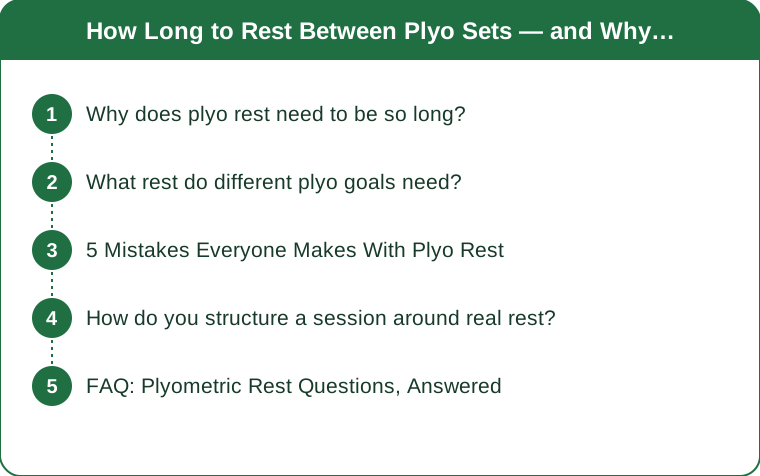
Why does plyo rest need to be so long?
Because the fuel system behind maximal jumps refills slowly and nothing speeds it up.
Explosive efforts run on phosphocreatine. A maximal jump lasts under a second and draws on an energy pathway that is essentially instant and essentially small. It replenishes about halfway in 30 seconds and needs roughly 3 minutes to get back near full.
Nervous system recovery lags behind how you feel. The recruitment of high-threshold motor units — the ones producing your best jumps — declines faster than your breathing suggests. You will feel ready at 45 seconds and jump measurably lower.
Quality is the whole point of plyometrics. The adaptation comes from the height and the speed of the ground contact, not from accumulating jumps. A rep at 85 percent of your best does not train power; it trains fatigue tolerance, which is a different session.
Landing mechanics degrade before output does. Ground contact time lengthens and knee control loosens a rep or two before your jump height falls. Short rest means most of your reps happen on the wrong side of that line.
The tissue itself takes eccentric load. Every landing is a controlled deceleration, and tendon stiffness — the property that makes jumps efficient — depends on being fresh when you produce it.
What rest do different plyo goals need?
Match the clock to what you are actually training.
Maximal power: 2 to 3 minutes, 3 to 6 reps per set. Box jumps, broad jumps, depth jumps. Low reps, full rest, and you stop the exercise the moment jump quality drops rather than when the set count says so.
Reactive strength: 90 seconds to 2 minutes, 6 to 10 contacts. Pogo hops, low bounds, ankle-driven work. Contacts are shorter and less taxing, so recovery is faster, but the same quality rule applies.
Plyometric endurance: 45 to 60 seconds, higher reps. This is a legitimate goal for court and field sports, but train it deliberately and separately. Do not let it happen by accident on a power day.
Total contacts per session matter more than sets. For a general fitness plan, 60 to 100 ground contacts is a normal weekly range for lower-intensity work, and 40 or fewer for high-intensity depth work. Count them; you will almost certainly find you have been doing more than you thought.
Two sessions a week with 48 to 72 hours between them. The connective tissue timeline, not the muscular one, sets that spacing.

5 Mistakes Everyone Makes With Plyo Rest
1. Filling the rest with something else. Doing push-ups between jump sets is a superset, and it works — for conditioning. If the goal is power, the rest is the training, not wasted time.
2. Using a timer for the set and a feeling for the rest. It is backwards. Set length can be governed by rep quality; rest length is the part that needs the clock, because your perception of recovery is the thing that is unreliable.
3. Assuming a lower box needs less rest. Height changes the intensity of the landing but not much about the energy system driving the takeoff. A maximal effort at a low height is still a maximal effort.
4. Putting plyos at the end of the workout. After 40 minutes of squats, you are training fatigued jumping. Plyometrics belong immediately after the warm-up, before any heavy strength work — the third mistake here surprises people who think of jumps as a finisher.
5. Ignoring the sound. Landings get audibly louder as fatigue accumulates. If set three is noticeably noisier than set one, rest was too short — your ears are a more honest fatigue monitor than your legs.
If you have a current joint injury, are returning from a lower-limb surgery, or have pain during landings, get a professional assessment before adding jump volume. This is general information, not medical advice.
How do you structure a session around real rest?
Fewer sets, longer gaps, and something useful in between that does not cost anything.
Build the session backwards from total contacts. Decide on 40 contacts, then divide into sets of 5. Eight sets at 3 minutes rest is a 30-minute session, and that is a complete power workout.
Use the rest for mobility that does not fatigue. Ankle circles, thoracic rotations, easy walking. Static stretching of the calves and quads right before a jump slightly reduces peak power, so keep it gentle and general.
Track jump height on the first and last set. A drop of more than 5 percent means the session went long or rest went short. It is the simplest quality control you have.
Pair jumps with a heavy lift if you want contrast training. A set of 3 heavy squats followed 3 minutes later by 3 jumps is a well-established method — the rest interval is what makes it work rather than what dilutes it.
Stop the session on the rep, not on the plan. When two consecutive reps look slower or land louder, the productive part of the workout is over regardless of what the program says.
FAQ: Plyometric Rest Questions, Answered
Is 60 seconds ever enough between plyo sets?
For low-intensity reactive work like pogo hops or line hops, yes. For anything maximal — box jumps, depth jumps, broad jumps — 60 seconds leaves you at roughly 85 percent of your phosphocreatine stores, which shows up directly as lower jump height on the following set.
Should I rest longer as I get more advanced?
Often yes, which surprises people. Stronger athletes produce more force per jump and deplete more per rep, so their recovery need can be higher, not lower. Better conditioning shortens how long you feel tired, not how long the energy system takes to refill.
Can I do plyometrics on back-to-back days?
Not at meaningful intensity. Tendon and connective tissue recovery from repeated impact runs 48 to 72 hours, and it lags well behind how your muscles feel. Two quality sessions a week beats four mediocre ones by a wide margin.
TL;DR:
- Rest 2 to 3 minutes between maximal plyo sets; the phosphocreatine system needs about 3 minutes to refill.
- Count total ground contacts, not sets — 40 or fewer for high-intensity work, 60 to 100 weekly for lighter work.
- Landing noise and ground contact time degrade before jump height does; both are early stop signals.
- Put jumps right after the warm-up, and keep the rest genuinely empty rather than supersetting through it.
Long rest feels lazy and produces better jumps. That is the trade almost nobody makes, and it is why so many jump programs stall while the effort keeps rising.
Keep Reading
This article is for general informational and styling purposes only. Fit, sizing, and product availability may vary.