Why Your Jump Height Is Lower in the Morning Than in the Evening
Quick Answer: Most people jump 2 to 5% lower in the early morning than in the late afternoon. Core temperature is at its daily low around 5am and peaks around 5pm, and warmer muscle produces force faster. Tendons are also stiffer after a night of lying still. You can claw back most of the gap with a 15 to 20 minute warm-up instead of the 5 minutes you would need at 6pm — the time of day is not the problem, the length of your on-ramp is.
You did the same session two weeks apart. Same shoes, same box, same rest.
The 6pm version felt springy. The 7am version felt like jumping in sand, and the tape measure agreed.
Nothing about your training went backwards. Your body simply runs a temperature schedule, and jumping is one of the qualities most sensitive to it — which is why the same program can feel like two different programs depending on when you run it.

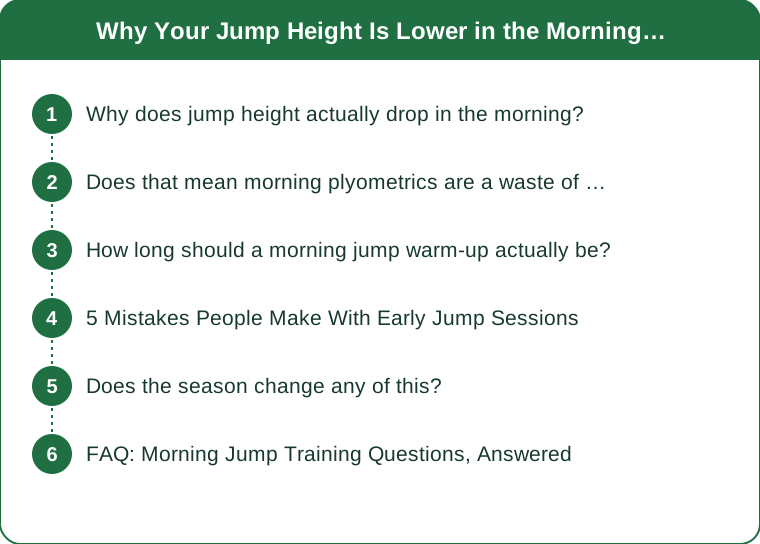
Why does jump height actually drop in the morning?
Three things stack up, and none of them are about motivation.
Core temperature is at its floor. Your body temperature bottoms out roughly two hours before you naturally wake and peaks in the late afternoon — a swing of about 1°C. Muscle fibres contract faster when they are warm, and jumping is almost pure rate of force development. A slightly cooler muscle is a slightly slower muscle.
Tendons are stiffer and less elastic. A jump is not just a muscular push, it is an elastic rebound through the Achilles and patellar tendons. After seven hours horizontal, connective tissue has had no cyclic loading at all. It takes repeated low-level bouncing to restore normal stiffness.
Your nervous system is still ramping. Peak voluntary drive — how completely you can recruit fast-twitch fibres — follows a similar daily curve. In the first hour after waking you are simply not able to fully turn on the tissue you have.
Put together, most testing shows a 2 to 5% deficit in vertical jump early in the morning compared with late afternoon. On a 20-inch vertical that is roughly half an inch to an inch.
Does that mean morning plyometrics are a waste of time?
No — but it does mean you should stop judging morning sessions by afternoon numbers.
The adaptation you get from jump training comes from high-quality ground contacts, not from hitting a personal record. A morning session at 95% of your best height, done with sharp landings and full rest, drives the same adaptation as an evening session at 100%.
What genuinely does suffer is testing. If you retest your vertical every six weeks, run every single test at the same time of day. Comparing a July evening test to a September morning test tells you about your circadian rhythm, not your training.
There is also a real upside: the body adapts to when you train. Train consistently at 7am and after a few weeks your morning performance curve lifts toward your afternoon one. It does not close entirely, but it narrows.
How long should a morning jump warm-up actually be?
Roughly three times longer than you think, and structured rather than casual.
Here is a 18-minute morning on-ramp that closes most of the gap:
- 4 minutes easy cardio — brisk walk on an incline, bike, skipping without rope. The goal is a light sweat, not fatigue.
- 4 minutes ankle and calf work — 2 sets of 15 slow calf raises, 30 seconds of ankle circles each side. Tendon stiffness responds to repeated loading, not to stretching.
- 4 minutes of pogo hops — 4 sets of 15 short, stiff bounces off the balls of the feet with barely bent knees. This is the single most useful item on the list.
- 3 minutes of ramp-up jumps — 5 jumps at 60%, 4 at 75%, 3 at 90%.
- 3 minutes rest before the working set.
Compare that with 6pm, where five minutes of pogos and a few build-up jumps is genuinely enough. The session length does not change — the ratio does.

5 Mistakes People Make With Early Jump Sessions
1. Treating stretching as a warm-up. Long static holds before jumping temporarily reduce power output. Save them for after.
2. Jumping straight into max effort. The first three jumps of a cold morning session are where non-contact Achilles complaints show up. Ramp.
3. Copying the evening rest periods. Cold tissue fatigues faster and recovers slower. Add 15 to 30 seconds to each rest interval in the morning.
4. Training on a cold floor. A garage or basement in September can sit at 14°C. Cold rubber is harder, cold feet feel less, and landing feedback gets worse. Warm the room or warm the shoes.
5. Comparing today’s number to yesterday’s. Sleep, hydration and the previous evening’s meal all move morning output by more than a session of training does. The third one on this list surprises even experienced coaches — rest intervals are almost never adjusted for time of day.
Does the season change any of this?
It does, and late August into September is exactly when people notice.
Morning air temperature drops before daytime temperature does. A 6:30am session that felt fine in July suddenly starts in 10 to 13°C air by mid-September, while the afternoon still hits the mid-twenties. The morning-to-evening performance gap widens with that spread.
Two practical adjustments as the mornings cool:
- Keep a long-sleeve layer on through the warm-up and take it off for working sets. Skin cooling drops muscle temperature faster than you expect between reps.
- Move contact volume down about 10 to 15% on cold mornings and keep intensity high. Fewer, better jumps beats a full volume day performed slowly.
If your training block ends in autumn, plan your retest for the afternoon and be honest with yourself about why.
FAQ: Morning Jump Training Questions, Answered
Is it dangerous to do plyometrics first thing in the morning?
Not inherently, but the margin for error is smaller. The elevated risk comes from cold, stiff tendons meeting high-impact landings without a ramp. With a 15 to 20 minute progressive warm-up, morning jump training is about as safe as any other time.
How soon after waking can I jump?
Give yourself at least 60 to 90 minutes upright before high-intensity jumping if you can. Spinal discs also rehydrate overnight, which is one more reason very early loaded jumping feels heavy.
Will training in the morning permanently lower my jump?
No. Your absolute ceiling is set by strength, elasticity and technique. Morning training simply means each session runs slightly below your daily peak, and the body partly adapts to the schedule you keep.
This is general information, not medical advice. Persistent pain in the Achilles, knee or shin during jumping deserves an in-person assessment.
TL;DR:
- Morning vertical typically runs 2 to 5% below your late-afternoon number because core temperature is at its daily low and tendons are stiff from a night of stillness.
- The adaptation still happens — only testing is affected, so always retest at the same time of day.
- Extend the warm-up to 15 to 20 minutes, with pogo hops doing most of the work, and add 15 to 30 seconds to each rest interval.
- As autumn mornings cool, keep a layer on through the warm-up and trim contact volume by 10 to 15% rather than dropping intensity.
Train when you can actually train consistently. A 7am session you never miss beats a 6pm session you make twice a month, and the small circadian tax is the cheapest thing you will pay all year.
Keep Reading
This article is for general informational and styling purposes only. Fit, sizing, and product availability may vary.