Why Your Jump Quality Drops Long Before You Feel Tired
Quick Answer: Plyometrics train the rate at which you produce force, and that quality degrades well before muscular or cardiovascular fatigue registers. Once ground contact time lengthens or jump height drops by more than about 10 percent, you have stopped training power and started training something else. The practical rule is to stop the set on the first noticeably slower rep, keep total contacts low, and take much longer rest than feels necessary - 60 to 90 seconds minimum between short sets.
The set feels fine. Your breathing is fine. And your third-to-last jump was already worse than your first.
This is the training modality where feeling fine is the least useful signal you have.

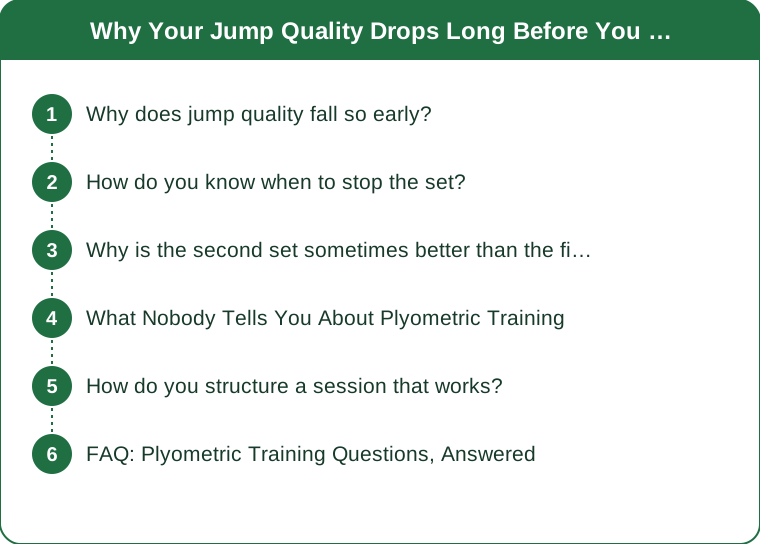
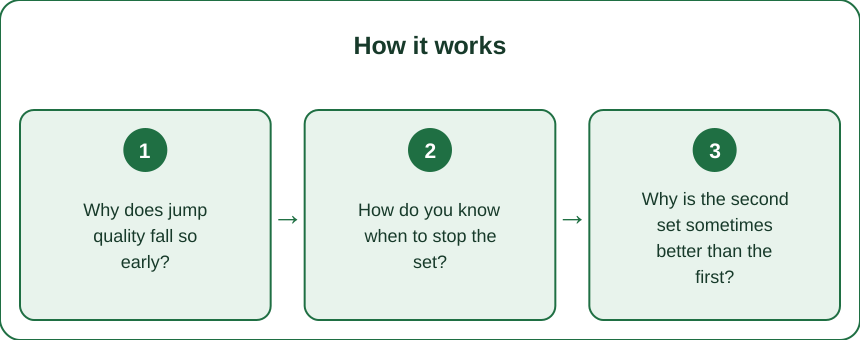
Why does jump quality fall so early?
Plyometrics train rate of force development, which depends on the nervous system’s ability to recruit high-threshold motor units fast. That capacity fatigues quickly and independently of how tired your muscles feel.
The stretch-shortening cycle is the mechanism being trained, and it depends on a rapid transition from landing to takeoff. Fatigue lengthens that transition, at which point you are performing a slow strength exercise instead of a plyometric one.
Ground contact time is the key variable. True plyometric work for most jump exercises sits under about 250 milliseconds. Longer, and elastic energy stored on landing dissipates as heat rather than contributing to takeoff.
Muscular fatigue arrives much later, which is exactly why perceived effort is a poor guide here. You will feel capable of many more reps than are useful.
Landing mechanics degrade alongside output, and degraded landings are where injury risk sits. Louder landings are the audible version of this.
And more volume produces less adaptation past the quality threshold, because the nervous system adapts to what you actually did, which after rep eight was no longer explosive.
How do you know when to stop the set?
Stop on the first noticeably slower or lower rep. Not after several - on the first. This single rule does more for plyometric training than any programming detail.
Listen to your landings. They get louder as fatigue accumulates because you are absorbing less actively. A set that starts quiet and turns loud has gone on too long.
Use a fixed reference for jump height - a mark on the wall, a box you touch, a chalk line. Once you drop more than roughly 10 percent below your best rep, the set is over.
Count contacts rather than sets and reps. Total ground contacts per session is the standard volume metric, and beginners are typically advised toward roughly 60 to 100 contacts, intermediates 100 to 150.
Keep sets short - three to six reps for most jump exercises, not ten to fifteen.
Rest far longer than feels needed: 60 to 90 seconds for short sets, two to three minutes for demanding ones. The rest is the training, because it is what preserves quality in the next set.
And put plyometrics at the start of the session, after a warm-up and before strength work. Plyometrics performed after squats are strength endurance work with a jump-shaped disguise.
Why is the second set sometimes better than the first?
Post-activation potentiation is real. A prior bout of intense muscle activity can temporarily increase force production, which is why set two often out-jumps set one.
The first set is also incompletely warmed up in terms of the specific neural pattern, even after a good general warm-up.
Which means your first set should be treated as a ramp, not as a measured effort. Two or three submaximal jumps before the first real set resolve most of it.
The effect has a window. Potentiation peaks a few minutes after the stimulus and fades, so very long rests lose the benefit that moderately long rests capture.
Fatigue and potentiation compete throughout the session, and the crossover point is where quality starts falling. Tracking jump height by set is the only way to actually see where yours is.
And it varies by individual and by training status, with stronger athletes generally showing more potentiation and needing more rest to express it.

What Nobody Tells You About Plyometric Training
Your jumps can feel heavy the day after an easy session. Neural fatigue outlasts muscular soreness and does not correlate with how hard the session felt. An easy plyometric session can leave you flat the next day while a hard squat session does not.
Landing is the trainable skill, not jumping. Most beginners spend all their attention on takeoff. Deceleration capacity is what limits progression and what protects the joints, and drop-landings without a rebound are legitimate training.
Surface matters enormously. Concrete is unforgiving, thick foam mats absorb the elastic response you are trying to train, and a wooden gym floor or rubber track is the sweet spot. Grass is a good outdoor option.
Box jumps are frequently the least useful exercise in the category as commonly performed, because a high box measures how far you can tuck your knees rather than how high you jumped. Step down; never jump down from a tall box.
Strength is the prerequisite. A common guideline suggests a reasonable base of lower-body strength before adding significant plyometric volume, because eccentric loads on landing are high.
Two sessions a week is enough for almost everyone, with at least 48 hours between them.
And the smallest jumps are often the most useful. Pogo hops and low ankle bounces train the stiffest, fastest end of the stretch-shortening cycle, and they are the exercises everyone skips in favour of something that looks impressive.
How do you structure a session that works?
Warm up thoroughly - eight to ten minutes minimum, including general movement, dynamic mobility and progressively faster low-level hops.
Start with the lowest-intensity variations: ankle pogos, line hops, low skips.
Progress to moderate: squat jumps, split jumps, lateral bounds.
Finish with the highest intensity only if quality is still there: depth jumps and single-leg work, which have the highest eccentric loads.
Keep the whole plyometric block to 15 to 20 minutes. Longer means you are past quality regardless of what the plan said.
Then do your strength work, which tolerates fatigue in a way plyometrics do not.
Log jump height or distance per set, because without a number you have no way to detect the degradation this entire article is about.
And progress by intensity before volume - harder variations at the same contact count, rather than more contacts of the same thing. This is general information, not medical advice.
FAQ: Plyometric Training Questions, Answered
How many ground contacts should a session have?
Beginners are commonly guided toward roughly 60 to 100 contacts per session, intermediates 100 to 150. Quality determines the real number - stop when jump height drops.
How much rest between plyometric sets?
60 to 90 seconds for short low-intensity sets, two to three minutes for demanding ones. If in doubt, rest more; the rest is what preserves the quality being trained.
Should plyometrics come before or after strength work?
Before, after a full warm-up. Plyometrics performed on fatigued legs stop being plyometrics.
Do I need to be strong before starting?
A reasonable base of lower-body strength is widely recommended, because landing forces are high. Low-intensity variations like pogos and line hops are appropriate much earlier than depth jumps.
Why do box jumps get criticised?
Because a tall box rewards knee tuck rather than jump height, and jumping down from height adds eccentric load with no benefit. Use a moderate box and step down.
How often should I do plyometric training?
Two sessions a week suits most people, with at least 48 hours between them. Neural fatigue outlasts soreness, so more frequency usually means worse quality. This is general information, not medical advice.
TL;DR:
- Plyometrics train rate of force development, which fatigues well before you feel tired.
- Ground contact time under about 250ms is the target; longer means you are doing slow strength work.
- Stop the set on the first noticeably slower or lower rep - not after several.
- Count total ground contacts, keep sets to three to six reps, and rest 60 to 90 seconds minimum.
- Louder landings are the audible signal that quality has gone.
- Low pogo hops are the most useful and most skipped exercise in the category.
Put plyometrics first in the session and log jump height per set. This is general information, not medical advice.
Keep Reading
This article is for general informational and styling purposes only. Fit, sizing, and product availability may vary.