What the Sound of Your Landing Actually Tells You About Plyometric Form
Quick Answer: A loud, heavy landing sound during plyometric exercises usually indicates the body is absorbing force abruptly through the joints rather than gradually through the muscles, while a quieter landing typically reflects better eccentric control — meaning landing sound is a surprisingly reliable, low-tech form check most people ignore.
Coaches often cue ‘land quietly’ specifically because the sound itself is a fast proxy for how well force is being absorbed.

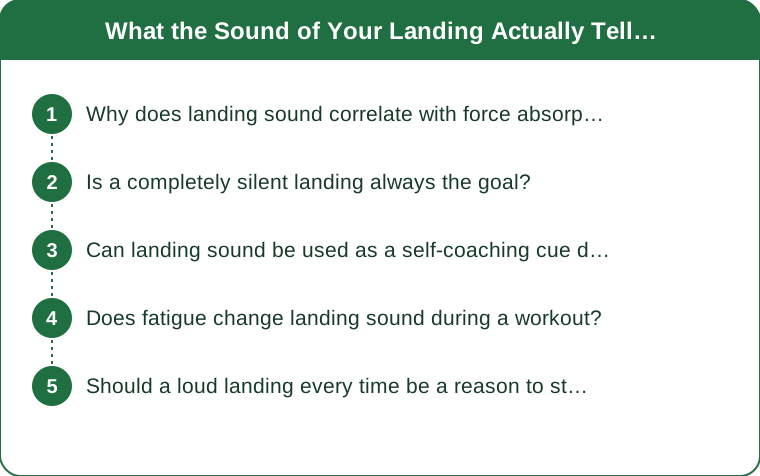
Why does landing sound correlate with force absorption?
A loud landing generally means the foot, ankle, and knee are decelerating body weight very quickly over a short time window, transferring more of that force into joints and connective tissue. A quieter landing usually means the same deceleration is happening over a slightly longer time window, with muscles — particularly the calves, quads, and glutes — absorbing more of the load eccentrically instead.
Is a completely silent landing always the goal?
Not necessarily silent, but noticeably softer — some sound is unavoidable with any real jump, and chasing complete silence can sometimes lead to overly cautious, incomplete landings; the useful goal is a controlled, absorbed landing rather than literal silence for its own sake.

Can landing sound be used as a self-coaching cue during training?
Yes, effectively — many coaches use ‘land like you don’t want anyone to hear you’ as a simple, intuitive cue precisely because it doesn’t require detailed technical instruction to trigger better bending at the ankle, knee, and hip on landing, which is the actual mechanism behind quieter landings.
Does fatigue change landing sound during a workout?
Yes, often noticeably — landings tend to get louder later in a plyometric set or session as fatigue reduces the muscles’ ability to control eccentric deceleration, which is a useful signal that form is breaking down and a set might need to end even if rep count targets haven’t been hit.
Should a loud landing every time be a reason to stop?
A single loud landing isn’t necessarily a problem, but a consistent pattern of loud landings across a session, especially compared to earlier in the same workout, is a reasonable signal to reduce volume or intensity rather than pushing through with degraded landing mechanics.
TL;DR:
- Loud landings usually mean force is being absorbed abruptly through joints, not muscle
- The goal is a controlled, softer landing rather than complete silence
- ‘Land quietly’ works as a coaching cue because it naturally improves joint bending on landing
- Landings getting louder over a session is a useful fatigue and form signal
Listening to your own landings is a free, effective form check most plyometric training ignores.
Keep Reading
This article is for general informational and styling purposes only. Fit, sizing, and product availability may vary.