Plyometric Progressions: The Jump-Training Ladder From First Hop to Box Jump
Plyometrics fail people in one predictable way — the jump attempted before the landing is owned — and the fix is a ladder where every rung earns the next. The progression guide: the landing-first curriculum, the phase-by-phase ladder and the volume discipline.

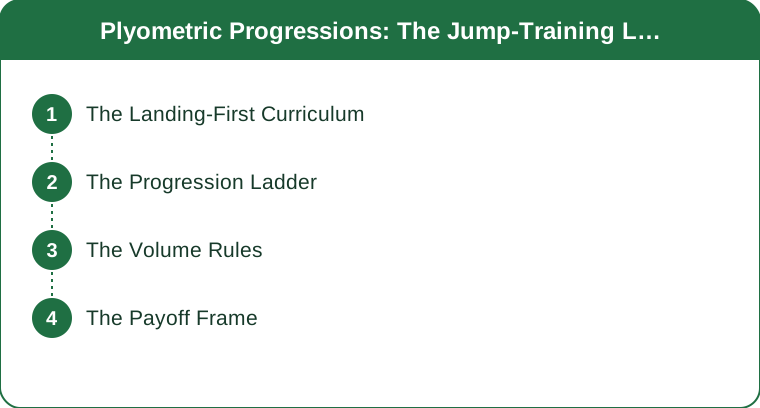
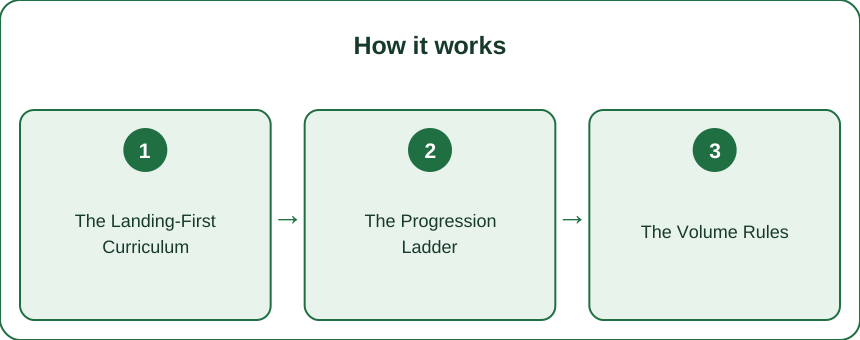
The Landing-First Curriculum
The skill before the spring: the landing priority (the force-absorption being plyo’s actual foundation — the injury risk living in landings, not takeoffs; the quiet-landing standard from the plyo doctrine), the landing mechanics (the hips-back knees-tracking soft-ankle triple — the ninja-quiet cue; the stick-and-hold two seconds; the knees-caving audit from the knee doctrine), the drop-and-stick drill (the step-off from a low box landing soft — the landing practiced WITHOUT the jump; the entry drill for week one), the single-leg landing tier (the hop-and-stick progression — the balance-and-absorption combination from the balance doctrine; the ankle-sprain insurance from the comeback doctrine), and the readiness gate (the strength prerequisite — the bodyweight squat competence and the calf capacity from the strength doctrine; the plyo built ON strength, never instead of it).
The Progression Ladder
Phase by phase: phase one — the in-place tier (the pogo hops and ankle bounces — the elastic-ankle training; the jump-and-stick squat jumps at half effort; the skipping rope from the conditioning doctrine as the daily elastic dose), phase two — the small-obstacle tier (the line hops front-back and side-side — the low-hurdle step-overs becoming hops; the broad-jump-and-stick with the landing standard held), phase three — the box introduction (the LOW box law — the mid-shin start; the box jump being a hip-hinge explosion, not a knee-tuck trick; the STEP-DOWN-always rule: the jump-down being the injury tier, the step-down being free), phase four — the single-leg-and-lateral tier (the single-leg pogo lines, the lateral bounds skater-style — the sport-adjacent patterns from the agility doctrine), phase five — the reactive tier (the depth-drop-to-jump connections — the contact-time-minimizing hops; the advanced tier earned across months, not weeks), and the rung rule (each phase held two-plus weeks at quality — the boring-before-advancing law from the progression doctrine).

The Volume Rules
The joint-happy dose: the contact-counting system (the foot contacts as plyo’s currency — the 40-60 contacts per session beginner ceiling; the quality collapse being the session’s real end per the fatigue doctrine), the frequency cap (the two weekly sessions with 48-plus hours between — the tendon-recovery math from the tendon doctrine; the plyo NEVER daily), the placement craft (the jumps EARLY in sessions while fresh — the post-fatigue plyo being the injury recipe; the warm-up requirement from the warm-up doctrine), the surface notes (the forgiving surfaces for volume — the grass, track and rubber floors; the concrete minimized), the progression variable discipline (the height OR volume OR complexity raised — never two at once per the one-change doctrine), and the population adjustments (the bone-density case for impact from the bone doctrine — the postpartum and floor-symptomatic readers routing through the leakproof ladder first; the masters athletes on the same ladder at gentler rungs per the masters doctrine).
The Payoff Frame
Why climb the ladder: the power dividend (the fast-twitch training from the muscle doctrine — the age-defying speed reserve; the daily-life translation: the catch-yourself reflex, the stair bound, the toddler chase from the grandparent doctrine), the bone deposit (the impact as bone medicine from the bone doctrine — the hops being density training in disguise), the athletic transfer (the jump that powers the tennis split-step, the HYROX burpees and the dance leaps from the respective doctrines), the efficiency note (the ten-minute plyo block twice weekly being the complete dose — the minimal doctrine’s power wing), the visible-progress joy (the box that grows, the bound that lengthens — the measurable ladder from the tracking doctrine), and the invitation close (the first rung being a step-off-and-stick from a curb — today; the spring built rung by patient rung; the landing owned, the flight earned). Land quiet first, count contacts, step down always: the ladder, climbed safely.
Own the landing before the jump: drop-and-stick drills first, then pogo hops, line hops, LOW boxes (step down, never jump down), then laterals and reactive work. Cap sessions at 40-60 contacts twice weekly, and raise height OR volume, never both.
Keep Reading
This article is for general informational and styling purposes only. Fit, sizing, and product availability may vary.