How Much Recovery Time Plyometric Training Actually Needs Between Sessions
Quick Answer: Most fitness guidelines suggest 48-72 hours of recovery between plyometric sessions targeting the same muscle groups, because the high-impact, fast-twitch demand of jump training creates more neuromuscular fatigue than the muscle soreness alone suggests.
Plyo workouts often don’t leave you as sore as a heavy lifting session, which tricks a lot of people into training them more frequently than the body can actually recover from.

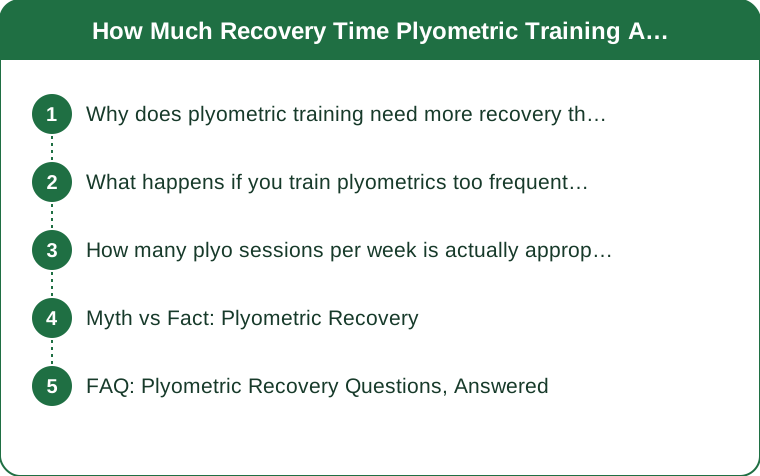
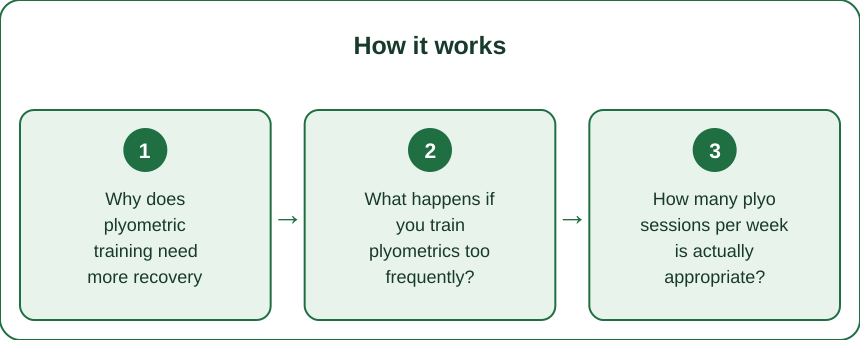
Why does plyometric training need more recovery than it seems to?
Plyometric exercises rely heavily on the stretch-shortening cycle, a rapid muscle lengthening-then-contracting action that places significant stress on the nervous system, tendons, and connective tissue — not just the muscles themselves. This neuromuscular fatigue doesn’t always show up as soreness, which is part of why people underestimate how much recovery time is actually needed.
What happens if you train plyometrics too frequently?
Insufficient recovery between plyo sessions is associated with declining jump height and power output over time, along with increased injury risk to tendons, particularly the Achilles and patellar tendon, which take longer to adapt than muscle tissue does. Ironically, training plyo too often can make you less explosive, not more, because the tissue never fully adapts between sessions.

How many plyo sessions per week is actually appropriate?
For most recreational trainees, 2-3 plyometric sessions per week, with at least 48 hours between them, provides enough stimulus for improvement without exceeding recovery capacity. Athletes in dedicated power-training phases sometimes push to more frequent, lower-volume sessions, but that requires more careful monitoring than most general fitness routines call for.
Myth vs Fact: Plyometric Recovery
Myth: If you’re not sore, you can train plyo again the next day. Fact: Neuromuscular and tendon fatigue from plyo often isn’t reflected in soreness levels, so lack of soreness isn’t a reliable recovery signal.
Myth: More frequent plyo training always builds explosiveness faster. Fact: Insufficient recovery can actually reduce jump height and power output over time.
Myth: Plyometrics are only risky for people who are new to exercise. Fact: Overtraining risk applies to experienced athletes too if recovery time is consistently cut short.
FAQ: Plyometric Recovery Questions, Answered
Can I do light cardio on plyo recovery days?
Yes, generally — low-impact activity like walking or easy cycling doesn’t interfere with the same recovery processes plyo demands, unlike another high-impact jump session.
How do I know if I’m not recovering enough between plyo sessions?
Watch for declining jump height, unusual tendon soreness that lingers past 48 hours, or feeling unusually flat and unexplosive at the start of a session — all are signs to add an extra rest day.
Does age affect how much plyo recovery time is needed?
Generally yes — tendon recovery capacity tends to slow somewhat with age, so erring toward the 72-hour end of the recovery window becomes more worthwhile over time.
TL;DR:
- Plyometric training needs 48-72 hours of recovery between sessions targeting the same muscles
- The stretch-shortening cycle creates neuromuscular and tendon fatigue that soreness doesn’t fully reflect
- Training too frequently can reduce jump height and power over time, not improve it
- 2-3 sessions per week with adequate spacing is appropriate for most recreational trainees
If your plyo sessions have started feeling less explosive rather than more, check your recovery spacing first — it’s a more common culprit than a lack of effort.
Keep Reading
This article is for general informational and styling purposes only. Fit, sizing, and product availability may vary.