Should Plyometrics Come Before or After Strength Work?
Quick Answer: Put plyometrics before strength work when the goal is power and rate of force development, because those qualities require a fresh nervous system and degrade quickly with fatigue. Put them after when the goal is conditioning or work capacity, and accept that landing quality will be lower. For most people training for athleticism, the correct order is warm-up, plyometrics, heavy strength, accessories.
You finish squats, then do three sets of box jumps because they seem like a finisher. That session trained fatigue tolerance. If you wanted power, you did it backwards.

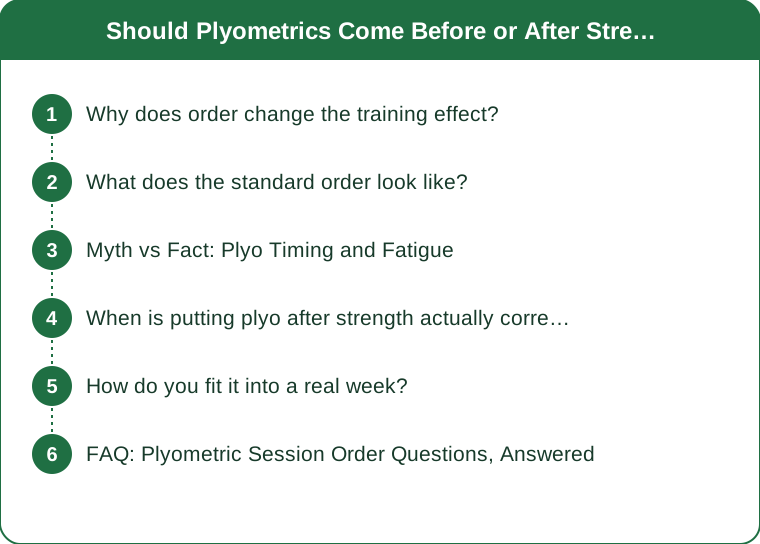
Why does order change the training effect?
Because power and strength depend on different qualities, and one of them is far more fragile.
Strength is largely about maximal force production, and it holds up reasonably well under moderate fatigue. You can grind out a heavy set when tired; it is slower, but it happens.
Power depends on rate of force development, how quickly you can produce force, and that quality degrades quickly. Jump height, ground contact time, and reactive stiffness all decline measurably once the nervous system is fatigued, and they decline before you subjectively feel tired.
The adaptation follows the quality you actually express. If your jumps are 15 percent below your best because you just squatted, you are training a slower jump, and the nervous system adapts to what it repeatedly does.
This is the whole argument for order, and it is why every serious power development program in sport puts explosive work early in the session. You cannot train fast while moving slow.
What does the standard order look like?
For a session targeting athleticism, the sequence is consistent across most programming approaches.
1. General warm-up, 5-8 minutes. Raise temperature, get blood moving. Nothing complicated.
2. Movement prep and low-level jumps. Pogos, ankle hops, skips. These are both warm-up and technique work.
3. Main plyometrics, low volume, full recovery. This is the quality block. Typically 20-40 total ground contacts for higher-intensity work, with 60-90 seconds or more between sets. Long rest is not optional; it is the mechanism.
4. Heavy strength work. Squats, hinges, presses.
5. Accessories and conditioning.
The part people resist most is the low volume with long rest in step 3. Twenty contacts feels like nothing. It is enough, because you are training quality and every contact after quality drops is a contact that trains the wrong thing.
The rule for ending a plyometric set: stop when height drops or landings get louder, not when you hit a rep number.
Myth vs Fact: Plyo Timing and Fatigue
Myth: Plyometrics are a good finisher. Fact: As a conditioning finisher they are effective and as power training they are close to useless. Both can be true. Just know which one you are buying.
Myth: You need to be exhausted for it to count. Fact: The opposite for power. High-quality, low-volume work with long rest produces the adaptation. Feeling like you did nothing is often a sign you did it correctly.
Myth: Post-activation potentiation means you should lift first. Fact: PAP is real, where a heavy set can temporarily enhance subsequent explosive output, but it requires specific timing, moderate rather than exhausting loads, and several minutes of rest. It is an advanced technique, not a justification for jumping after five sets of squats.
Myth: More ground contacts means more progress. Fact: Contact volume is the primary driver of both adaptation and injury risk in plyometrics, and beginners routinely do three times what is useful. Counting contacts is the most underused practice in the whole area.
The one that changes sessions immediately: landing quality drops before you feel tired. Your subjective sense of fatigue lags the actual decline in reactive ability, which means “I still feel fine” is not a reason to keep going. Height and sound are better indicators than feel.

When is putting plyo after strength actually correct?
Three legitimate cases, and they are all deliberate rather than accidental.
Conditioning blocks. If the goal is work capacity or a metabolic effect, doing low-intensity jumps under fatigue is a valid stimulus. Keep the intensity genuinely low, meaning skips and low hops rather than depth jumps or high box jumps.
Sport-specific fatigue tolerance. Athletes in sports where jumping happens late in a game benefit from some exposure to jumping while tired. This is a small, specific part of an advanced program, not a default.
Time constraints on a general fitness program. If you have 45 minutes twice a week and strength is the priority, doing a small amount of low-intensity plyometric work after lifting is better than doing none. Just choose exercises with a low landing demand.
What is not a legitimate case: doing depth jumps, high box jumps, or bounding after heavy lower-body work. Those have the highest force and the highest technical demand, and doing them fatigued is where the injury risk in plyometrics actually concentrates.
This is general information, not medical advice. Anyone with knee, ankle, or Achilles issues should get individual guidance before adding plyometric volume.
How do you fit it into a real week?
Two to three plyometric sessions per week is the usual range, with at least 48 hours between higher-intensity sessions.
A practical two-day template for someone lifting three times a week:
Day 1 (lower body): warm-up, pogos and ankle hops, then 3 sets of 5 countermovement jumps with 90 seconds rest, then squats and hinges. Roughly 30 contacts.
Day 2 (upper or full body): warm-up, skips and low bounds, then 3 sets of 6 lateral hops per side, then the lift. Roughly 40 lower-intensity contacts.
Day 3: no plyometrics, or very low-level rope skipping in the warm-up only.
Progress by intensity before volume. Moving from a countermovement jump to a depth jump is a bigger step than adding two sets, and it should come after months rather than weeks.
And track contacts. Writing down “30 contacts, all good height” takes five seconds and gives you the one number that governs both progress and risk in this training. Most people who get hurt doing plyometrics did far more contacts than they realized, spread across a warm-up, a class, and a finisher.
FAQ: Plyometric Session Order Questions, Answered
Can I do plyometrics on a separate day entirely?
Yes, and it is arguably the cleanest option. A short dedicated session of 20-30 minutes with full freshness produces excellent quality, and it removes the ordering question completely.
What about upper body plyometrics?
Same principle. Medicine ball throws and clap push-ups belong early in the session, before pressing work, for the same rate-of-force-development reasons.
Is jumping rope plyometric training?
Low-level, yes. It is useful as warm-up and conditioning and it does contribute to your contact count, which is worth remembering if you skip rope for ten minutes and then do box jumps. It does not replace higher-intensity work for developing power.
TL;DR:
- Power depends on rate of force development, which degrades under fatigue faster than strength does
- Default order: warm-up, low-level hops, main plyometrics with long rest, then heavy lifting
- Keep high-intensity work to roughly 20-40 quality contacts and stop when height drops or landings get loud
- Plyo after lifting is valid for conditioning, never for depth jumps or high box jumps
Move the box jumps to the front of the session and cut the reps in half. Same time in the gym, completely different adaptation.
Keep Reading
This article is for general informational and styling purposes only. Fit, sizing, and product availability may vary.