Why Ground Contact Time Matters More Than Jump Height
Quick Answer: Plyometric training develops the stretch-shortening cycle - your tendons’ ability to store and return elastic energy - and that only works when ground contact is brief, generally under about 0.25 seconds. A tall jump with a slow, deep contact is largely a strength exercise; the same height with a fast contact is genuinely reactive. Height tells you how much force you produced. Contact time tells you how quickly you produced it - and speed of force production is what plyometrics exists to train.
Which means the box height you are chasing may be actively working against you.

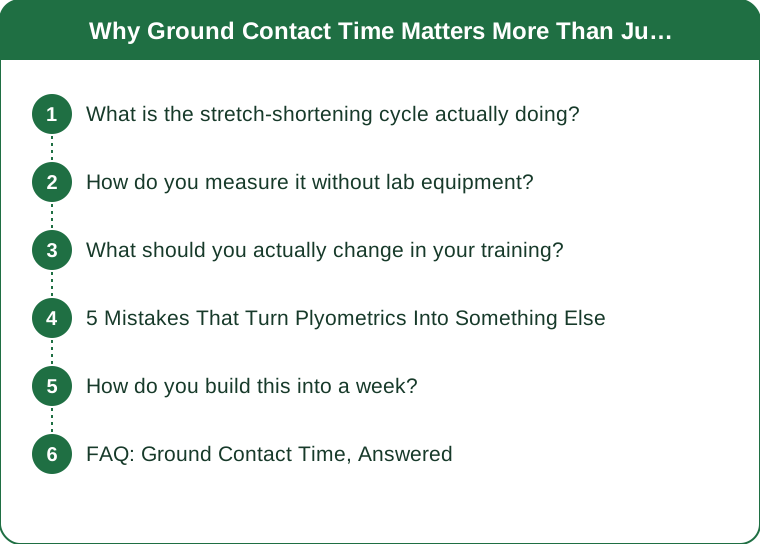
What is the stretch-shortening cycle actually doing?
It is an elastic mechanism, and it has a time limit.
When a muscle-tendon unit is rapidly stretched, the tendon stores elastic energy like a stretched rubber band. If the muscle then shortens immediately, that stored energy is returned and adds to the force your muscle produces on its own.
The catch is that the energy dissipates as heat very quickly. Delay the transition from landing to takeoff and the elastic contribution falls away. What starts as a reactive jump becomes a slow concentric effort from a squat position - useful, but a different exercise entirely.
The commonly used threshold is around 0.25 seconds of ground contact for fast stretch-shortening cycle work, with slow SSC work sitting above that. Sprinting ground contacts are far briefer than that, and most sporting actions that matter sit at the fast end.
So the same drill can be two different exercises. A depth jump with a crisp rebound trains reactivity. The same depth jump where you land, sink, pause, and jump trains concentric strength - and if reactivity was the goal, you did not get it.
This is why ‘how high’ is such a poor measure. Height rewards a deeper countermovement and a longer contact, which is exactly the opposite of what you were trying to build.
How do you measure it without lab equipment?
Reasonably well, with things you already have.
Sound is the most accessible proxy. A short, sharp single sound is a brief contact. A drawn-out or double sound - land, shuffle, jump - is a long one. Coaches have used this forever because it works.
Film it and count frames. A phone at 240fps gives you frames of about 4 milliseconds each. Count frames from first foot contact to last foot contact and multiply. This is genuinely accurate enough for training decisions and takes two minutes.
Use a rhythm constraint. Set a metronome or count aloud, and jump to a fixed cadence. If you cannot keep the rhythm, the contact has lengthened - which usually means fatigue.
Reactive Strength Index is the formal version: jump height divided by ground contact time. It captures the trade-off directly - a slightly lower jump with a much faster contact scores better, which is precisely the point. You can compute a rough version from a phone video.
And the simplest field test: the third-rep rule. Do five continuous rebound jumps. The rep where the sound changes or the rhythm breaks is your working limit for that day, and it is often rep three or four rather than rep ten.
Track it session to session rather than chasing a number. The useful signal is when your contact time starts lengthening within a set, because that is the moment the training stimulus changed.
What should you actually change in your training?
Mostly the instruction and the volume, not the exercises.
Change the cue from ‘jump high’ to ‘get off the ground fast’. This one change alters the movement immediately. Instructional focus measurably changes ground contact time, and it costs nothing to apply.
Lower the box. Box height for depth jumps should be chosen by the highest drop from which you can still land and rebound quickly, not by what you can survive. For most people that is far lower than they use - and a box that is too tall guarantees a long, absorbing contact.
Cut set length. Quality collapses fast. Sets of 3 to 6 contacts for reactive work, with full rest, beat sets of 15. Long sets turn a plyometric session into a conditioning session with plyometric-shaped risk.
Rest properly. One to two minutes minimum between short reactive sets; more for demanding drills. Incomplete rest is the most common reason contact times drift long in an otherwise well-designed session.
Count contacts, not sets. Total foot contacts per session is the standard volume measure. Beginners commonly start in the low dozens per session and build gradually - and the number matters far less than stopping while quality holds.
Do it fresh. Reactive work belongs early in a session, after the warm-up and before heavy strength work or conditioning. Plyometrics done at the end of a workout is contact-time training in name only.
And separate the two goals deliberately. Some sessions can target height with deep countermovements and long contacts - that is legitimate strength-speed work. Just do not confuse it with reactive training, and do not expect one session to deliver both.

5 Mistakes That Turn Plyometrics Into Something Else
1. Choosing the box by ego. A box you can barely clear forces a deep, slow landing on the way down. Drop height should be set by the highest box from which your rebound stays crisp - typically much lower than people expect, and often surprisingly low for beginners.
2. Long sets. Contact quality degrades within a handful of reps. A set of 20 jumps is mostly practice at jumping badly, and the last 15 reps carry the injury risk without the training benefit.
3. Doing them tired. At the end of a session, after conditioning, or on a bad sleep week. Fatigued tendons and slower reflexes lengthen contact times and raise injury risk simultaneously - the worst combination available.
4. Landing softly as a virtue. ‘Land soft’ is good advice for landing-only drills and bad advice for reactive work, where a soft, absorbing landing is exactly the energy leak you are trying to eliminate. For rebound jumps, the aim is stiff and brief - which is different from harsh or uncontrolled.
5. Progressing height instead of quality. More height, more box, more reps - all easy to measure and all beside the point. Progression in reactive work means the same output with a shorter contact, which is unglamorous and correct.
The one that surprises people: your second set is often better than your first, and your fourth is usually worse than both. Potentiation is real - a light warm-up jump set genuinely improves the next one - but the window is short, and pushing past it undoes everything you just gained.
How do you build this into a week?
Modest volume, high quality, and enough recovery.
Two sessions a week is a workable frequency for most people doing reactive work alongside other training. Tendons adapt more slowly than muscles, and the tissue that limits your progress here is the one that needs the most recovery time.
Leave at least 48 hours between plyometric sessions, and more if soreness is still present. Plyometric soreness classically peaks around 48 hours because of the eccentric loading involved, and training on top of it is how people accumulate problems.
Build a base first. General strength - especially the ability to squat and land under control - should precede reactive work. A commonly cited readiness marker is being able to control your bodyweight in a single-leg squat and land a drop from a low box without wobble.
Progress in this order: landings only, then low-amplitude rebounds, then bilateral jumps, then single-leg work, then drop jumps from increasing height. Skipping to depth jumps is the most common way people get hurt in this training.
Watch the surface. Harder surfaces produce shorter contact times and higher impact forces. A gym floor or track is appropriate; concrete is not, and grass absorbs so much that reactive quality suffers.
And back off when contact times lengthen across a whole session rather than pushing through. A session that starts with crisp contacts and ends with heavy ones is telling you the productive part is over - and the remainder is accumulating fatigue for no benefit.
This is general fitness information, not medical advice. If you have a history of Achilles, patellar tendon, or knee injury, or you are returning from an injury, work with a qualified coach or physiotherapist before adding jump training - plyometrics is one of the training methods where progression errors have real consequences.
FAQ: Ground Contact Time, Answered
What counts as a fast ground contact?
For fast stretch-shortening cycle work, roughly under 0.25 seconds is the commonly used threshold. Above that, the elastic contribution has largely dissipated and the movement is closer to a concentric strength exercise.
Can I measure this with just my phone?
Yes. Film at a high frame rate and count frames from first foot contact to last. At 240fps each frame is about 4 milliseconds, which is precise enough for training decisions.
Should I stop trying to jump higher?
Not at all - just know which quality you are training. Maximum height with a deep countermovement is strength-speed work. Reactive work needs brief contacts, and mixing the cues within one set gets you neither cleanly.
How many jumps should I do per session?
Start low - a few dozen total foot contacts is a common beginner range - in sets of 3 to 6 with full rest. The stopping rule matters more than the number: stop when contact quality changes.
Why does everything feel worse on the third set?
Reactive quality degrades quickly with fatigue, and tendon stiffness drops. That is normal. The mistake is continuing, since the remaining sets carry the risk without the benefit.
How high should the box be for depth jumps?
The highest box from which you can still rebound crisply. For most people that is considerably lower than the box they would choose by feel, and starting low is the correct error to make.
TL;DR:
- Plyometrics trains the stretch-shortening cycle, and the stored elastic energy dissipates within a fraction of a second.
- Under roughly 0.25 seconds of ground contact is the usual threshold for fast reactive work; slower than that is a strength exercise wearing a jump costume.
- Height rewards a deeper, longer contact - the exact opposite of the quality you are trying to build.
- Measure with sound, a 240fps phone video, or a rhythm constraint; Reactive Strength Index is jump height divided by contact time.
- Change the cue to ‘get off the ground fast’, lower the box, and keep sets to 3 to 6 contacts with full rest.
- Do reactive work fresh and early, twice a week, with at least 48 hours between sessions.
- Progression means the same output with a shorter contact - not a taller box.
If the sound of your landing changes, the productive part of the set is already over.
This is general information, not medical advice.
Keep Reading
This article is for general informational and styling purposes only. Fit, sizing, and product availability may vary.