Why Your Landing Quality Drops Before You Feel Tired
Quick Answer: The nervous system’s ability to coordinate a fast, precise landing declines before your subjective sense of tiredness catches up. Landing mechanics measurably deteriorate while the set still feels manageable, which is why plyometric training is programmed by quality and rep caps rather than by how tired you feel.
The set felt fine. You had more in you. And the video shows your knees collapsing inward on rep seven, three reps before you felt anything at all.

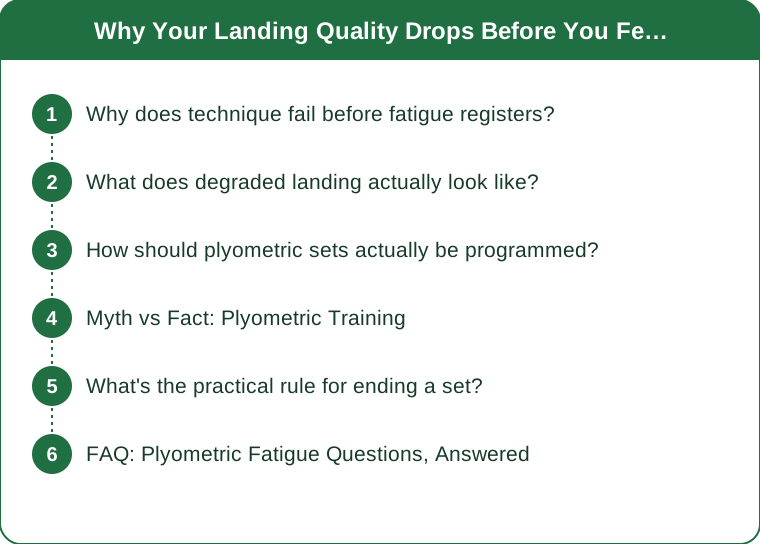
Why does technique fail before fatigue registers?
Plyometric quality depends on rapid, precise neuromuscular coordination — force production and absorption compressed into a very short window. That coordination is more fatigue-sensitive than raw force output.
Your perception of effort tracks metabolic and cardiovascular signals fairly well, and neural coordination fairly poorly. So the system that’s degrading first is the one you have the least conscious access to, which is precisely why plyometrics are the worst possible place to use go until you feel tired as a stopping rule.
What does degraded landing actually look like?
The reliable early signals are visible on video even when they’re invisible from the inside: knees drifting inward on landing (valgus), a louder landing than earlier reps, less knee and hip bend on contact, and longer ground contact time between reps.
Sound is the most useful cue you can monitor in real time. Landings get louder as the muscles absorb less and the joints absorb more. If rep six is audibly louder than rep two, the set is over — that’s not a judgment call, it’s just what the noise means.
How should plyometric sets actually be programmed?
By low rep counts with full recovery, which is the standard approach for exactly this reason. Sets in the range of 3-6 quality reps, with 1-2 minutes of rest between sets, keep every rep in the high-quality window.
Total weekly foot contacts are the usual volume metric, and beginners are typically kept well below the volumes used by trained athletes. Longer rest feels excessive and isn’t — the recovery is for the nervous system, not the lungs, and it takes longer than your breathing suggests.

Myth vs Fact: Plyometric Training
Myth: More reps means more power development. Fact: Power adaptations come from high-quality reps. Reps performed after quality degrades train a slower, less coordinated pattern.
Myth: Feeling the burn means it’s working. Fact: A burning sensation indicates metabolic fatigue, which is the opposite of the state plyometrics are supposed to be performed in.
Myth: Box jumps should be about box height. Fact: Box height mostly measures how well you can tuck your knees. The training effect lives in the takeoff and the landing, not the number on the box.
Myth: Plyometrics are a finisher. Fact: They belong early in a session, after warm-up and before fatiguing work — the exact opposite of how they’re most often programmed.
What’s the practical rule for ending a set?
Use an objective cutoff decided before the set starts, not a judgment made during it. Three options that work: stop at a fixed low rep count regardless of how you feel, stop at the first audibly louder landing, or stop the moment ground contact visibly lengthens.
Filming one set a month from the front is worth more than any amount of internal monitoring — knee valgus is genuinely difficult to feel and immediately obvious on video. And if the last rep of a set ever feels like the hardest one, the set already ran long.
FAQ: Plyometric Fatigue Questions, Answered
How many plyometric sessions per week is reasonable?
Two is a common recommendation for most non-athletes, with at least 48 hours between sessions given the high eccentric loading involved.
Are step-downs from the box necessary?
Stepping down rather than jumping down removes a large, unprogrammed eccentric load from every rep. For most people, stepping down is the better default.
Should plyometrics come before or after strength work?
Before. They demand a fresh nervous system, and doing them after heavy lifting places them squarely in the degraded-quality zone this whole article is about.
TL;DR:
- Neural coordination fatigues before your subjective sense of tiredness registers it
- Louder landings and longer ground contact are the earliest reliable warning signs
- Program by low rep counts with full recovery, not by feel
- Plyometrics belong early in a session, not as a finisher
- Film one set occasionally — knee collapse is hard to feel and easy to see
Decide where the set ends before it starts. That single habit removes most of the risk that makes plyometrics look dangerous.
Keep Reading
This article is for general informational and styling purposes only. Fit, sizing, and product availability may vary.