Why Plyometric Power Often Plateaus Well Before General Strength Does
Quick Answer: Strength and power are related but distinct qualities — strength measures maximum force production, while power measures how quickly that force can be applied, and pure strength training without dedicated fast, explosive practice doesn’t automatically teach the nervous system to express force quickly, which is why jump height and explosive power can plateau even as strength numbers keep climbing.
Getting stronger raises your ceiling for power, but it doesn’t automatically teach your body to reach that ceiling quickly — that takes separate, dedicated practice.

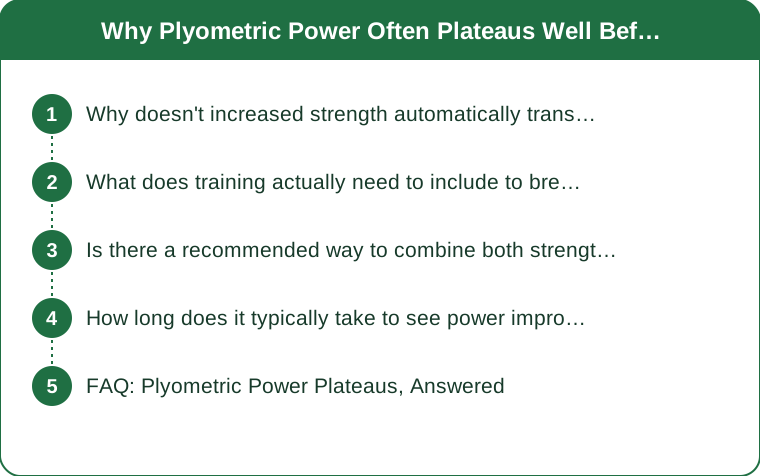
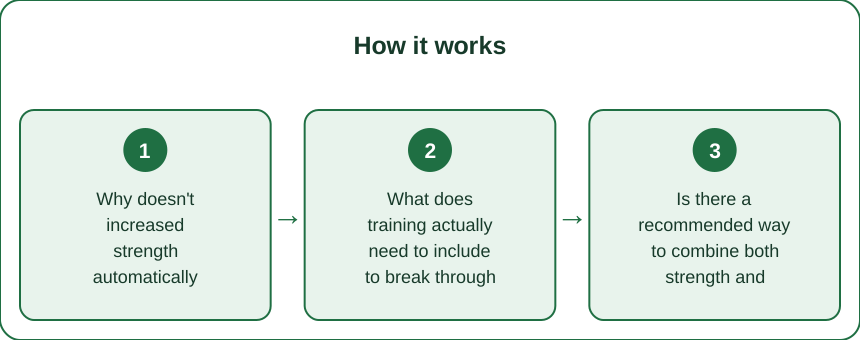
Why doesn’t increased strength automatically translate to more power?
Power depends on the rate of force development — how fast force is applied — not just how much total force is available. Heavy strength training builds maximum force capacity but trains relatively slow movement speeds, which doesn’t specifically train the nervous system to fire quickly, the separate skill power actually requires.
What does training actually need to include to break through this plateau?
Explosive, fast-intent movements performed at lower loads and higher velocity — plyometrics, jump training, and Olympic lift variations specifically — train the nervous system’s ability to express available strength quickly, which pure heavy lifting alone doesn’t fully address.

Is there a recommended way to combine both strength and power training?
Many programs pair a heavy strength exercise with an explosive plyometric movement targeting the same muscle group in the same session (a technique called contrast training), which appears to reinforce the connection between raw strength and the ability to express it quickly.
How long does it typically take to see power improvements once this gap is addressed?
Consistent explosive training over four to eight weeks typically produces measurable jump height and power improvements, since the nervous system adaptations involved happen somewhat faster than the structural adaptations behind pure strength gains.
FAQ: Plyometric Power Plateaus, Answered
Should I stop strength training to focus entirely on power work?
No — strength training still raises your overall power ceiling, so the goal is adding dedicated explosive work alongside it, not replacing it entirely.
Is plyometric training risky if I haven’t done it before?
Starting conservatively with lower-impact plyometric variations and progressing gradually reduces injury risk considerably compared to jumping straight into high-intensity jump training.
Does this power plateau issue apply to everyday activities, or just athletic performance?
It applies to any activity requiring quick, forceful movement — quickly catching your balance, for example — so addressing it has practical value beyond pure athletic performance too.
TL;DR:
- Strength and power are related but distinct qualities trained differently
- Power depends on how fast force is applied, not just how much force is available
- Explosive, fast-intent training specifically addresses the rate-of-force-development gap
- Pairing heavy strength work with plyometric movements can reinforce both qualities together
Keep Reading
This article is for general informational and styling purposes only. Fit, sizing, and product availability may vary.