Why Plyometric Soreness Shows Up Two Days Later, Not the Next Morning
Quick Answer: Plyometric soreness typically peaks 24-72 hours after training because the eccentric loading of landing causes microscopic muscle fiber damage that triggers an inflammatory repair response, and that response takes a day or two to fully ramp up — meaning the delay is a normal biological repair timeline, not a sign anything went wrong during the workout itself.
The workout felt fine. The next morning felt fine too. Then day two hit, and stairs suddenly became a project — that timeline isn’t random, and it isn’t a red flag either.

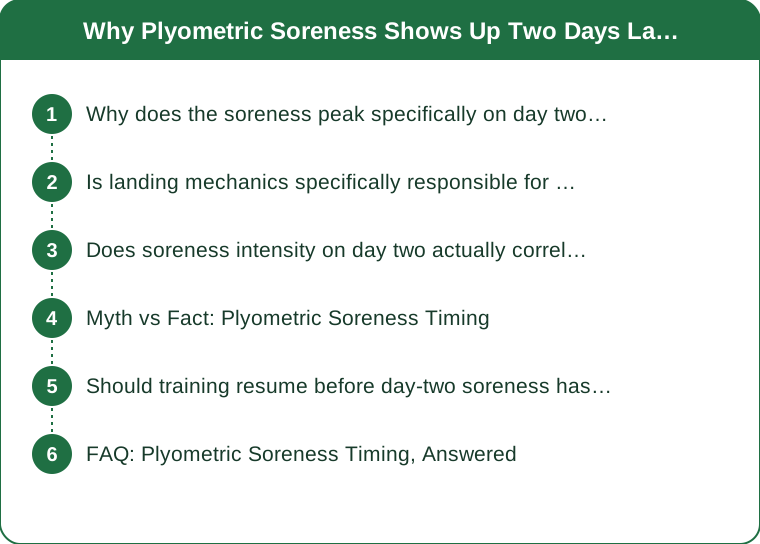
Why does the soreness peak specifically on day two instead of right after training?
The eccentric, force-absorbing landing phase of jump training creates microscopic tears in muscle fibers, and the inflammatory and repair processes your body launches in response build up gradually over roughly 24-48 hours before peaking, which is why delayed onset muscle soreness (DOMS) consistently shows up a day or two later rather than immediately.
Is landing mechanics specifically responsible for more soreness than the jumping itself?
Yes — the concentric, upward jumping phase uses muscles in a way that causes relatively little fiber damage, while the eccentric landing phase asks muscles to lengthen under load while absorbing impact force, and that lengthening-under-load pattern is the primary driver of the microscopic damage behind plyometric-specific soreness.
Does soreness intensity on day two actually correlate with how hard the session was?
Only loosely — a first plyometric session in weeks can produce significant day-two soreness even at moderate intensity, since unfamiliar eccentric loading causes more fiber damage than familiar loading does, meaning soreness level reflects novelty and eccentric demand as much as it reflects total training effort.

Myth vs Fact: Plyometric Soreness Timing
Myth: if you’re not sore the next morning, the workout wasn’t effective. Fact: next-morning comfort followed by day-two soreness is the expected, normal pattern for eccentric-heavy training like plyometrics, and it says nothing about whether the prior day’s session was hard enough or well-executed.
Should training resume before day-two soreness has fully resolved?
Light activity and gentle movement generally support recovery better than complete rest, but a second high-intensity plyometric session on muscles still moderately sore from day two typically increases injury risk without adding much training benefit, so most coaches recommend waiting until soreness has meaningfully eased before repeating high-impact jump work on the same muscle groups.
FAQ: Plyometric Soreness Timing, Answered
Does soreness decrease with repeated exposure to the same plyometric routine?
Yes — the repeated bout effect means muscles adapt to a specific eccentric loading pattern after a few exposures, so the same routine performed weekly typically produces progressively less day-two soreness over the first several weeks.
Is any soreness on day three or later still normal?
Some lingering soreness into day three is common, especially after a new or harder-than-usual session, but soreness that’s worsening rather than easing by day three, or accompanied by sharp joint pain, is worth having checked rather than pushed through.
Does stretching before or after plyometric training reduce day-two soreness?
Stretching has a minimal measurable effect on delayed onset soreness; a proper warm-up and gradual volume progression do far more to limit day-two soreness than stretching does.
TL;DR:
- Plyometric soreness peaks around 24-72 hours later because eccentric landing forces trigger an inflammatory repair process that builds gradually, not instantly
- Landing, not jumping, is the main driver of the microscopic muscle damage behind the soreness
- Feeling fine the morning after doesn’t mean the session was too easy — day-two soreness is the normal expected pattern
- Repeated exposure to the same routine reduces soreness over several weeks via the repeated bout effect
That day-two ache after a jump session is your body doing exactly what it’s supposed to do — repairing eccentric loading damage on its normal timeline, not signaling that something went wrong.
Keep Reading
This article is for general informational and styling purposes only. Fit, sizing, and product availability may vary.