Why Quiet Landings Are the Half of Jump Training Nobody Practices
Quick Answer: Every landing sends a force of roughly three to seven times your body weight through your legs, and the sound it makes tells you how that force was absorbed. A loud slap means the deceleration happened abruptly, in a stiff position, over a short distance. A quiet landing means the force was spread across more time and more joints. Training landings deliberately — with drop-and-stick drills and noise as your feedback — is what lets you add jump volume without your knees and shins paying for it.
If you have only ever trained the up part of the jump, this is the fastest quality you can improve this month.

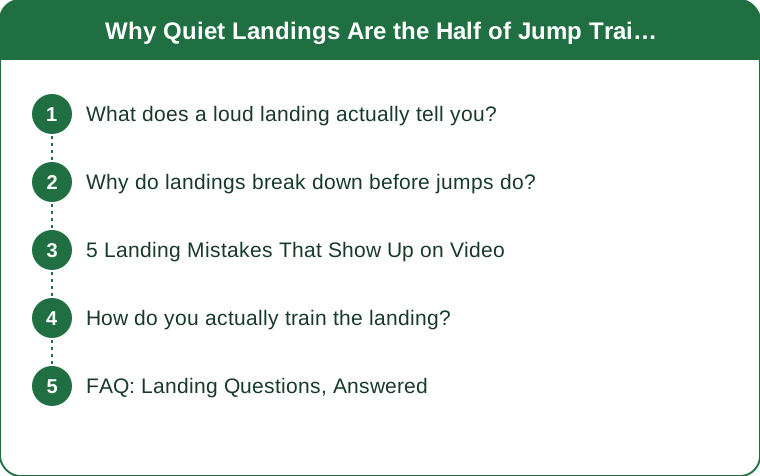
What does a loud landing actually tell you?
That the braking happened all at once, in a small range of motion.
Sound is energy that did not get absorbed smoothly. When you land stiff — knees nearly straight, hips tall, weight back on the heels — your body has only a couple of inches in which to stop, so the force spikes hard and fast. The floor slap you hear is that spike.
A quiet landing is the same amount of force spread over a longer path. The ankles give first, then the knees bend, then the hips fold, and each joint takes a share. Same energy, three times the distance, a fraction of the peak load.
This is why coaches obsess over landing noise. It is free, continuous biofeedback that requires no equipment and no filming. If your landings are loud, something in the chain — usually the hips — is refusing to participate.
There is a second layer to it. The tissues that absorb landing forces adapt to the loading they receive, but only at the rate connective tissue adapts, which is slower than muscle. A jumper who keeps adding height and volume on top of loud landings is stacking force spikes onto tendons that have not been given a reason or a chance to catch up.
The landing is not the boring part between reps. It is half the rep, and it is the half that decides how much jumping your body will tolerate.
Why do landings break down before jumps do?
Because landing is eccentric work, and eccentric quality is the first thing fatigue takes.
The jump itself is concentric — muscles shortening, producing force. The landing is eccentric — muscles lengthening under load while they brake. Eccentric control demands more precise coordination, and it degrades earlier in a session than jump height does.
Watch a set of ten jumps. Heights stay respectable through rep eight. But the landings tell a different story: by rep five the sound is louder, by rep seven the knees drift inward, by rep nine the person lands and stumbles a half step. The output looked fine long after the absorption had quit.
This matters for programming. If you set volume by how the jumps look, you will consistently overshoot what your landings can support, and that surplus is exactly where the aches accumulate — patellar tendons, shins, the front of the hips.
The fix is to make landing quality the stopping rule. The set ends on the first rep that lands loud or unstable, not the first rep that looks lower. For most people that produces sets of three to six, with real rest between them, which is precisely the dose that quality plyometric programs prescribe.
It also reframes what a session is for. You are not there to survive forty jumps. You are there to produce fifteen excellent takeoffs and fifteen silent landings, and to leave before the quality goes.

5 Landing Mistakes That Show Up on Video
Landing with the knees caving inward. The knees drift toward each other at the moment of impact, which loads the knee joint in a direction it handles poorly. The cue that works is to land with the feet under the hips and think about spreading the floor apart.
Landing heel-first with the weight behind you. The heel slam is the loudest landing there is, and it sends force up the chain with almost no muscular absorption. Aim for the front half of the foot touching first, heels kissing down a fraction later.
Collapsing too deep. The opposite error — absorbing so far that you sink into a full squat and pause there. It looks soft, but past a certain depth the muscles give up bracing and the position turns passive. A landing should finish in a quarter to half squat, loaded and ready.
Arms dead at the sides. The arms that drove up during the jump should sweep forward on the landing. They are a balance tool, and pinning them to your sides forces the trunk to make messy corrections.
Eyes down at the feet. Dropping your gaze rounds the upper back and tips your weight forward. Pick a spot at eye level and let the feet find the floor without supervision.
Film one set from the front and one from the side this week. The camera catches the inward knee drift and the heel slam long before you can feel either one.
How do you actually train the landing?
Separately first, with low heights and full attention, then folded back into your jumps.
Start with the drop-and-stick. Stand on a low box — six to twelve inches is plenty — step off, land, and hold the finish position dead still for two full seconds. No sound, no wobble, no extra step. Three to five reps, three sets. This isolates the absorption skill without asking you to produce anything.
Add the snapdown. From standing, swing the arms up tall, then snap down into your landing position without leaving the ground. It rehearses the shape and the speed of a landing with zero impact, which makes it a perfect warm-up drill on jump days.
Then pair every jump with a stuck landing. One jump, one silent stick, reset, repeat. The reset matters — walking it back and setting your stance is what keeps the quality honest.
Progress height only when silence comes with it. If a twelve-inch drop lands quiet and a twenty-inch drop lands loud, the twenty-inch box is ahead of your absorption, not your courage.
Dress for the work, too. Jump sessions are one of the places where gear genuinely matters: a supportive pair of training shoes with a stable base, a high-impact sports bra, and high-waisted leggings that stay put through repeated takeoffs beat any loose alternative, because nothing should be distracting you at the moment of impact.
This is general training information, not medical advice. If landings produce joint pain rather than muscle effort, get it assessed before you add height or volume.
FAQ: Landing Questions, Answered
Should you step down or jump down from a box jump?
Step down for most of your reps. It cuts the landing count in half, which lets you spend your absorption budget on the landings you actually train with intent, not the careless ones.
Do thick mats help or cheat?
Both, depending on the phase. A mat reduces peak force while you learn the shape, which is useful early. But mats also blur the feedback — everything sounds quiet on foam — so graduate to a firm surface once the pattern is stable.
Is barefoot landing practice a good idea?
Low drops and snapdowns barefoot can sharpen foot awareness if you are used to training shod, but keep heights conservative. The foot muscles need the same gradual on-ramp as everything else.
How quiet is quiet enough?
A soft, single contact sound — not silence, which is impossible, and not a double slap, which means heels crashed down late. If someone in the next room cannot tell you are jumping, you are there.
TL;DR:
- Landing sound is free biofeedback: loud means force spiked through a stiff position, quiet means it spread across ankles, knees, and hips.
- Landing quality degrades before jump height does, so end sets on the first loud or unstable landing, not the first low jump.
- Train absorption directly with drop-and-sticks and snapdowns, and hold every finish for two seconds.
- Progress box height only when silence comes with it, and step down between reps to save your landing budget.
Film one set this week and listen with your eyes closed. Your ears will find the problem faster than the mirror will.
Keep Reading
This article is for general informational and styling purposes only. Fit, sizing, and product availability may vary.