Why Single-Leg Jumps Expose What Double-Leg Jumps Hide
Quick Answer: Double-leg jumps let your stronger side take extra load without you noticing, so a 15 to 20 percent side-to-side gap can hide for years. Single-leg hops remove that option and expose it immediately — usually as a wobbly landing, a longer ground-contact time, or a knee that drifts inward on one side only.
Your box jump looks good. Your broad jump has been slowly improving. Then someone asks you to hop across the floor on one leg and it turns into a scene. Nothing has gotten worse — you just took away the thing that was covering for you.

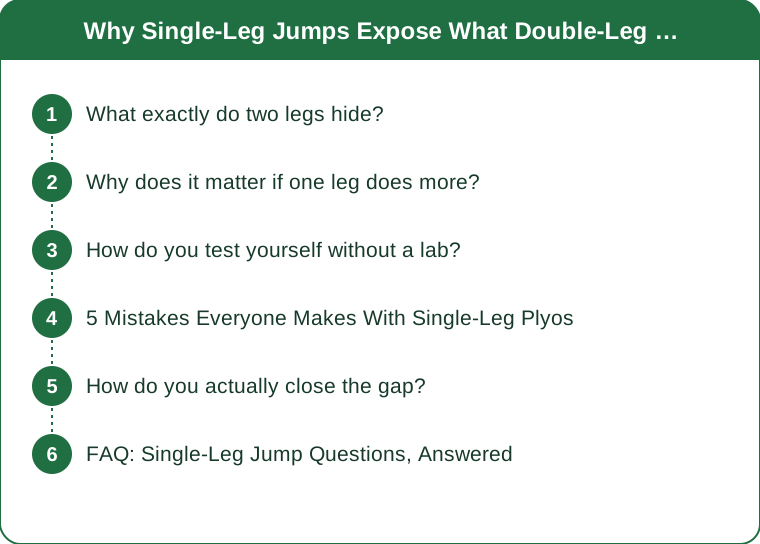
What exactly do two legs hide?
Load sharing. When you jump off both feet, your nervous system distributes the work in whatever way produces the highest jump, and it has no obligation to split it evenly.
Force-plate research on double-leg jumping consistently finds asymmetries of 10 to 20 percent between limbs in people who feel completely balanced. The jump height looks fine because the total force is fine. The distribution is not.
Three things get masked specifically:
- Force production — one leg produces more of the push-off
- Landing absorption — one leg accepts more of the impact, which matters more than the push-off for injury risk
- Balance and control — the second foot acts as a stabilizer, so you never have to demonstrate single-limb control at all
A single-leg hop removes all three safety nets at once. That is uncomfortable, and it is exactly why it is useful.
Why does it matter if one leg does more?
Because almost nothing you do athletically happens on two legs at once.
Running is a series of single-leg landings. Cutting, climbing stairs, stepping off a curb, chasing a toddler — all single-limb. Training exclusively on two legs builds a quality you then have to translate into a context you never practiced.
The injury angle is the more pointed one. The limb that habitually absorbs less load in training is the limb that is less prepared when it has to absorb full load alone, and the moment it has to do that tends to arrive without warning.
There is also a straightforward performance cost. If your left leg is producing 15 percent less force, your sprint mechanics are asymmetric, your stride is uneven, and you are leaving power on the table on every step. Fixing the weak side usually raises the double-leg number too, which is a pleasant surprise for people who assumed they had plateaued.
How do you test yourself without a lab?
Three tests, ten minutes, no equipment beyond a floor and a tape measure.
- Single-leg broad jump. Hop forward for distance off one leg, land on the same leg, hold the landing for two seconds. Three attempts per side, take the best. A gap larger than 10 percent between sides is worth addressing.
- Single-leg hop for time. Ten continuous small hops in place, timed. The slower side is usually the one with poorer stiffness and longer ground contact. Also notice which side you can do with your eyes closed.
- Landing quality, filmed. Step off a low box onto one leg and film from the front. Watch the knee. If it collapses inward on one side and tracks straight on the other, you have found something more useful than any distance measurement.
The hold-the-landing rule matters more than the distance. A jump you cannot stick is not a jump you own.

5 Mistakes Everyone Makes With Single-Leg Plyos
-
Starting with distance. The first goal is a stuck landing, not a long hop. Distance without control is just a longer fall.
-
Training the strong side first. Whatever you do first gets your freshest effort. Start every set on the weaker side, then match it with the stronger side rather than exceeding it.
-
Matching reps instead of quality. Doing eight per side when the weak side degrades at five means three junk reps that reinforce bad mechanics. Stop the set when landing quality drops, on both sides.
-
Ignoring the arms. The arm swing is part of the jump, and people often use a different arm pattern on their weak side without realizing it. Film it. This one surprises even experienced lifters.
-
Adding volume before earning it. Single-leg landings deliver roughly double the per-limb load of the double-leg version at the same height. Twenty single-leg contacts is not equivalent to twenty double-leg contacts — treat it as roughly twice the dose.
How do you actually close the gap?
Slowly, and with a lot less volume than you would expect.
A reasonable eight-week structure:
- Weeks 1 to 2 — landings only. Step down from a low surface onto one leg, stick, hold three seconds. 3 sets of 5 per side, twice weekly. No jumping up yet.
- Weeks 3 to 4 — small hops in place. Continuous low pogo hops, 3 sets of 8 to 10 per side, focusing on quiet contacts.
- Weeks 5 to 6 — directional hops. Forward, lateral, and diagonal single hops with a stuck landing. 3 sets of 4 per direction.
- Weeks 7 to 8 — continuous hops for distance and rebound. Now you can chase numbers.
Throughout, do one extra set on the weaker side and retest at week four. Most people close a 15 percent gap to under 8 percent in six to eight weeks, and the improvement shows up in the double-leg tests too.
A note on soreness: expect the weaker side to be considerably more sore for the first two weeks. That is the point. If it is sharp, localized joint pain rather than muscle soreness, stop and get it looked at — this is general information, not medical advice.
FAQ: Single-Leg Jump Questions, Answered
How big a difference between sides is normal?
Under 10 percent is generally considered acceptable, and small differences will always exist. Over 15 percent is worth deliberate work. Note that dominance is not always the direction you would guess — plenty of right-handed people jump better off the left.
Should I stop double-leg jumping while I fix this?
No. Keep it, and add single-leg work as a separate, lower-volume element. Double-leg jumps are still the better tool for building peak power; single-leg work is the tool for finding and fixing what the double-leg version hides.
How often should I retest?
Every four weeks is plenty. Testing more often adds fatigue without adding information, and day-to-day variation is large enough that a single test tells you less than you think.
TL;DR:
- Double-leg jumps let the stronger limb take extra load, hiding gaps of 10 to 20 percent
- Test with a single-leg broad jump, a timed hop, and a filmed single-leg landing
- A gap over 10 percent, or a knee that collapses on one side only, is worth eight weeks of dedicated work
- Start every set on the weaker side, prioritize stuck landings over distance, and halve your expected volume
The uncomfortable version of this is that most people’s weak side has been weak for years and nobody noticed because the strong side kept covering. The useful version is that it is one of the faster things to fix, and closing the gap almost always raises the numbers you actually care about.
Keep Reading
This article is for general informational and styling purposes only. Fit, sizing, and product availability may vary.