Why Your Arm Swing Decides More of Your Jump Height Than Your Legs
Quick Answer: A coordinated arm swing typically contributes around 10 to 20 percent of vertical jump height. It works by adding downward force through the body during the push phase and by transferring upward momentum at takeoff. Most people lose a large share of that contribution through mistimed or shortened arm action, which is why two people with the same squat strength can jump very differently.
If your jump has stalled while your leg strength keeps climbing, the arms are the first place to look — and they are far quicker to fix than adding another 20 pounds to your squat.

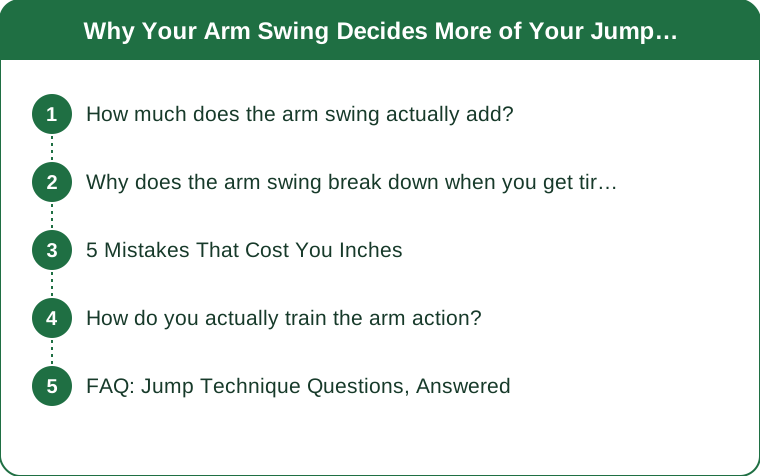
How much does the arm swing actually add?
More than most people assume, and it is measurable.
Studies comparing jumps performed with a free arm swing against jumps performed with hands fixed on the hips consistently find a difference of roughly 10 to 20 percent in jump height. For someone with a 20-inch vertical, that is two to four inches sitting entirely in technique.
The mechanism is not that the arms pull you up. It is subtler and more interesting.
During the downward phase of the jump, the arms swing back and down. That deceleration pushes force down through the body into the ground, which increases the load your legs are working against and lets them produce more force in return. Then, as the arms reverse and swing upward during the push, their momentum transfers into the body at exactly the moment your feet are leaving the floor.
The timing is the whole trick. The arms have to be still accelerating upward while your feet are still on the ground. If the arm swing finishes early, the momentum has nowhere to go. If it starts late, it is not adding load during the push phase.
This is a coordination skill, not a strength quality, which is why it responds to practice in weeks rather than months.
Why does the arm swing break down when you get tired?
Because it is the first thing your nervous system economizes on.
Watch any set of repeated jumps and you will see the same progression. Reps one through three have a full arm swing that goes from behind the hips to overhead. By rep six, the swing starts lower and finishes at shoulder height. By rep ten, the arms are barely moving.
Nobody decides to do this. The arms simply stop being driven with intent while the legs keep working, because the legs are the part you are consciously attending to.
The result is that your later reps in a set are not just fatigued versions of the early ones — they are a different movement. You are training a shortened, less coordinated jump pattern for the majority of your reps, then wondering why the pattern does not show up when it matters.
There is a second, sneakier version of this. In jumps that involve any hand task — catching a ball, touching a target, holding a light implement — the arm swing is constrained from the start. That is fine for sport specificity but it means those reps should not be counted as training your maximum jump pattern.
The practical fix: cap your sets at the rep where the arm swing shortens, not the rep where your legs get tired. For most people that is three to five reps, which is considerably shorter than they are used to. It is also why quality plyometric programs prescribe such low rep counts and long rests, a detail that gets ignored constantly.

5 Mistakes That Cost You Inches
Starting the arm swing from the front. If your arms begin hanging in front of your thighs, you have already given up half the range. The swing should start with the hands behind the hip line, which requires a deliberate backswing during the countermovement.
Stopping the swing at shoulder height. The arms should finish overhead, or as close as your mobility allows. Stopping early cuts off the momentum transfer at the exact moment it is worth the most.
Bending the elbows during the swing. A bent arm has less rotational inertia, which means less momentum for the same speed. Keeping the arms relatively straight through the upward drive is what makes the contribution significant.
Swinging the arms out to the sides. Any horizontal component is wasted energy that does not go into vertical height, and it often produces a rotation you then have to control in the air. Track the arms in a plane close to the body.
Timing the swing to the legs instead of leading with it. The arm reversal should begin fractionally before the leg drive, not after. The most common error is a jump where the legs fire and the arms follow, which puts the arm momentum into the air phase where it does nothing at all.
The third one surprises even experienced lifters — most people have never been told their elbow angle matters, and correcting it alone often produces a visible change in a single session.
How do you actually train the arm action?
Separately from the jump, then reintegrated.
Step one: practice the swing standing still. Feet planted, no jump. Swing from behind the hips to overhead, twenty times, focusing on straight arms and full range. This feels absurdly simple and it is the fastest way to expand the range you actually use.
Step two: pair it with a countermovement without leaving the floor. Dip into a quarter squat as the arms swing back, then extend the legs and drive the arms up while keeping the feet down. You are rehearsing the timing without the complication of the jump. Ten reps.
Step three: jump with an exaggerated swing. Three to five reps, maximum intent, with the specific instruction to finish the arms overhead. Expect it to feel uncoordinated for the first session or two.
Step four: test it. Jump three times with hands on hips, then three times with a full swing, and note the difference. If the gap is small, your swing is not contributing what it should be, and that is a clear target.
A useful weekly dose is two sessions of three to five maximal jumps with full rest — 60 to 90 seconds between reps, not between sets. Jump training rewards freshness far more than volume, and the arm swing is the clearest evidence of that: it is the first quality to disappear and the first to recover.
This is general training information, not medical advice. If jumping produces joint pain rather than muscular effort, get it assessed before adding volume.
FAQ: Jump Technique Questions, Answered
Does the arm swing help in a standing broad jump too?
Yes, and arguably more. In a horizontal jump the arms contribute both momentum and balance, and a restricted swing usually shows up as a short, unstable landing rather than just reduced distance.
Should I train jumps with weights to improve my vertical?
Strength work supports it, but the arm swing is one of the few variables you can improve without adding load at all. Fix the technique first — it is free, and it changes the baseline that all your strength work gets expressed through.
Why does my jump feel worse on the day after an easy session?
Usually accumulated fatigue in the fast-twitch qualities, which recover more slowly than perceived tiredness suggests. It is also the day when the arm swing quietly shortens without you noticing, so filming a set is worth more than trusting how it feels.
TL;DR:
- A full arm swing adds roughly 10 to 20 percent to jump height, through added load during the push and momentum transfer at takeoff.
- The swing must start behind the hips, stay relatively straight, and finish overhead while your feet are still down.
- It shortens with fatigue before your legs do, which is why quality jump sets are three to five reps.
- Practice the swing standing still, then reintegrate it — the change often shows up within a single session.
Film one set from the side this week. If your hands finish at shoulder height, you have found inches that cost nothing to reclaim.
Keep Reading
This article is for general informational and styling purposes only. Fit, sizing, and product availability may vary.