Why Your Jump Height Drops on the Third Set but Your Effort Goes Up
Quick Answer: Jump height depends on how fast you produce force, not how much force you can produce. Fatigue kills speed long before it kills strength, so by set three your muscles can still generate plenty of force but need an extra fraction of a second to do it, and that delay costs height. Effort feels higher because your nervous system is recruiting harder to compensate. The fix is not pushing through it: stop the exercise when height drops more than about 10 percent, because everything after that point trains slow jumping.
You warm up, do six jumps, and they feel almost too easy. Third set, same six jumps, and you are gritting your teeth for less height.
This blog has covered why landings get louder through a set and why your second set often beats your first. This is the mechanism underneath both, and it changes how many sets you should actually be doing.

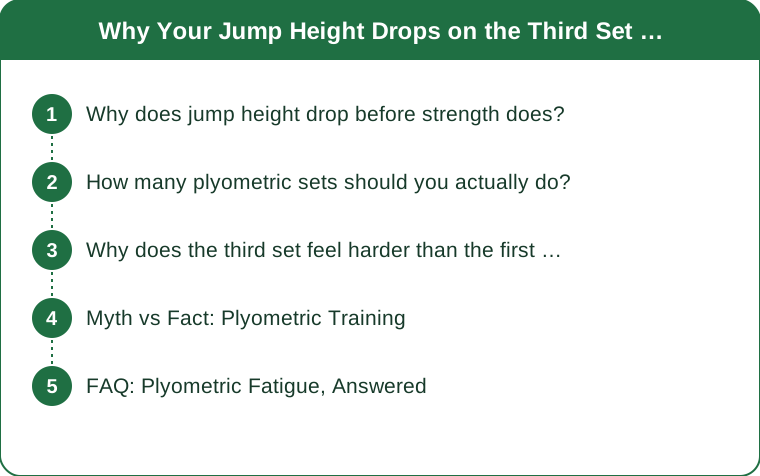
Why does jump height drop before strength does?
Because a jump is a speed event, and speed is the first thing fatigue takes.
Your muscles can produce a wide range of forces at a wide range of speeds, and those two things trade off. A heavy slow contraction and a light fast one can involve the same muscle. Jump height comes almost entirely from how much force you can apply in the roughly 0.2 seconds your foot is on the ground.
Fatigue slows the rate of force development first. Even a mildly fatigued muscle reaches peak force noticeably later than a fresh one. Your maximum force barely changes, but you no longer reach it before your foot leaves the ground, so a large part of your available force never gets used.
The stretch reflex also dulls. A good jump borrows elastic energy from the fast stretch of the landing or countermovement, and that reflex is highly sensitive to fatigue. When it dims, you are jumping with muscle alone rather than muscle plus spring.
Your ground contact time gets longer, which you can hear. More time on the ground means more elastic energy leaks away as heat instead of returning as height. This is exactly why the third set sounds heavier than the first.
And your body compensates by recruiting harder. Perceived effort tracks how much neural drive you are sending, not how high you go. Sending more drive to a slower system feels enormously harder for a worse result, which is precisely the sensation you are describing.
How many plyometric sets should you actually do?
Far fewer than most programs suggest, and the number is decided by your performance rather than a plan.
Use a 10 percent drop-off rule. Track your best jump of the session. When two jumps in a row fall more than roughly 10 percent below it, that exercise is finished for the day regardless of how many sets you had written down.
In practice that means 3 to 5 sets of 3 to 6 reps for most people. Low reps, long rests. If you can comfortably do 15 jumps in a row, you are doing conditioning, not plyometrics, and you will get conditioning results.
Rest 90 seconds to 3 minutes between sets. This feels absurdly long the first time and it is the single highest-value change most people can make. The rest exists to restore speed, not to catch your breath. If you are still breathing hard, you are also still slow.
Put plyometrics first in the session, right after the warm-up. Jumps done after squats are jumps done fatigued, which teaches your nervous system to produce force slowly. If you need to combine them, jumps before lifting.
Two sessions a week is plenty. Plyometrics are high-stress on tendons and connective tissue, which recover on a slower timeline than muscle. Soreness two days later is normal; joint ache is not.
And measure something. Marks on a wall, a phone slow-motion video, or simply counting how many reps you get before the sound changes. Without a number, drop-off is invisible and every set feels roughly the same in the moment.

Why does the third set feel harder than the first when the load is identical?
Because effort is a measure of what you are sending, not what you are getting.
Perceived effort comes from motor command, not muscle damage. Your brain estimates effort largely from the size of the signal it is sending out. Fatigued muscle fibres need a bigger signal for the same output, so the same jump costs more subjective effort.
Fast-twitch fibres fatigue disproportionately. They are the ones producing your jump height, and they are also the ones that tire fastest. As they drop out, your body recruits more of them harder, then starts leaning on slower fibres that cannot do the job.
Your landings get more demanding as you tire. Absorbing force well requires the same speed of contraction that producing it does. Late in a session you land stiffer and louder, which raises the effort cost of each rep and the tissue stress at the same time.
And the mental load rises. Fresh jumps happen almost automatically. Tired jumps require deliberate concentration on the movement, which itself registers as effort.
This is why the sensation is a useful signal rather than a problem to override. In strength training, the hardest reps are often the most productive ones. In plyometrics the opposite is true: the hardest-feeling reps are usually the least productive, because they are the slow ones.
Myth vs Fact: Plyometric Training
Myth: More jumps means more explosive power. Fact: Beyond the point where speed drops, extra jumps train slow force production and add joint stress without adding power. Quality window first, volume never.
Myth: You should feel wrecked after a plyometric session. Fact: A well-run plyometric session often ends while you still feel fresh. That is the session working, not you slacking. The stimulus is speed, and speed cannot be trained in a fatigued state.
Myth: Short rests make plyometrics more effective. Fact: Short rests convert plyometrics into conditioning. Both are valid training, but only one builds jump height, and mixing them means getting a diluted version of each.
Myth: Landing softly means you are not working hard enough. Fact: Quiet landings mean you are absorbing force efficiently through your hips and knees. Loud landings usually mean fatigue has arrived and your joints are taking impact your muscles should be handling.
Myth: You need a box or special equipment. Fact: Broad jumps, tuck jumps, and simple repeated hops on flat ground cover almost everything most people need. The box mostly reduces landing impact by letting you step down instead of dropping.
Myth: If your jumps are dropping, you need to push through and build endurance. Fact: Jump endurance is a real quality and it is trained differently and on a different day. Trying to build it inside a power session degrades the power session and does a mediocre job of the endurance one.
FAQ: Plyometric Fatigue, Answered
How do I know when to stop a plyometric set?
When your jumps drop roughly 10 percent below your best of the session, or when the landings audibly get louder and heavier. Both signal that ground contact time has lengthened and you are no longer training speed.
Is it bad to do plyometrics when I am already tired?
It is not dangerous in small doses, but it is unproductive and it raises injury risk because tired landings are stiffer. If you are fatigued, do them another day or cut the volume in half rather than pushing the usual amount.
Why is my second set sometimes better than my first?
Post-activation potentiation. The first set primes your nervous system, and if you are well rested, that priming outweighs the small fatigue cost. It usually disappears by set three, when accumulated fatigue takes over.
TL;DR:
- Jump height depends on rate of force development, and fatigue slows that down long before it reduces maximum strength.
- Effort rises on later sets because your nervous system sends a bigger signal to a slower system for a worse result.
- Stop the exercise when jumps fall about 10 percent below your best of the day, usually after 3 to 5 low-rep sets.
- Rest 90 seconds to 3 minutes, do jumps before lifting, and treat quiet landings as the quality marker.
The hardest habit to build here is stopping while you still feel capable. Track one number, trust the drop-off, and let the set end early.
Keep Reading
This article is for general informational and styling purposes only. Fit, sizing, and product availability may vary.