Why Your Plyometric Landings Get Louder as the Set Goes On
Quick Answer: Landings get louder because the muscles that absorb force fatigue faster than the muscles that produce it. You can still jump high after your ability to decelerate is gone, so the takeoff stays strong while the landing collapses. Noise is a real-time measure of how much force your joints are absorbing instead of your muscles — which makes it the best stop signal you have.
Rep one is almost silent. By rep six you can hear yourself two rooms away, and nobody has to tell you it looked worse.
This is not carelessness and it is not a cue problem. It is a specific, predictable order of fatigue, and once you understand it, the noise becomes the most useful feedback in the entire session.
Here is what is happening and exactly where to draw the line.

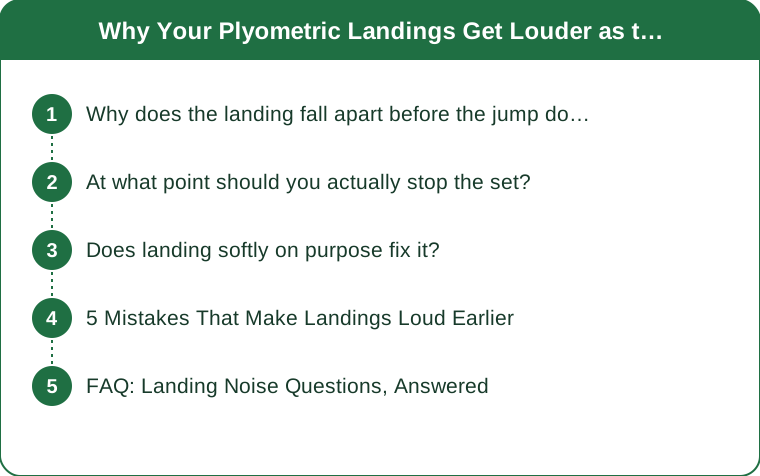
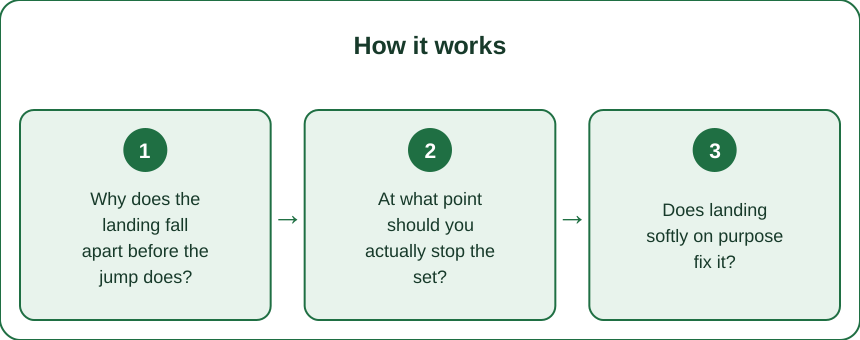
Why does the landing fall apart before the jump does?
Because absorbing force and producing force are different jobs, and one of them tires out first.
Eccentric control fatigues faster. The lengthening-under-load work your quads, glutes, and calves do on landing is metabolically expensive and neurally demanding. Research on jump protocols consistently shows landing mechanics degrading while jump height holds steady — sometimes for several more reps.
Your takeoff has a bigger safety margin. Concentric power drops gradually and obviously; you feel a lower jump immediately. Deceleration capacity drops off a cliff and you feel almost nothing, because your skeleton quietly takes over.
That is what the noise is. A quiet landing means muscle absorbed the force over a longer time. A loud landing means the force went in fast and hard through bone, cartilage, and connective tissue instead. Same jump height, entirely different load path.
Stiffness increases as you tire. Fatigued athletes land with straighter knees and less hip flex, which shortens the absorption distance. Less distance to spread the same force means higher peak force and more sound.
At what point should you actually stop the set?
When the sound changes — not when your legs feel done. The sound comes first.
Use the two-rep rule. If two consecutive landings are clearly louder than your first rep, the set is over. Not three more, not finish the number you planned. The reps after that point deliver joint stress without a training benefit you cannot get more safely.
Quality plyometrics are short. Most productive jump sets are 3 to 6 reps with 60 to 90 seconds of rest. If you are programming sets of 15, you are training something other than power, and the last 9 reps are where the noise lives.
Rest longer than feels necessary. Power output needs closer to 90 seconds than 30. Cutting rest is the fastest way to make every subsequent landing loud, and it converts a power session into a conditioning session by accident.
Total volume matters more than any single set. For most people, 30 to 60 quality contacts in a session is plenty. Counting contacts rather than sets makes it much harder to overshoot.

Does landing softly on purpose fix it?
Partly, and only while you are fresh. You cannot cue your way out of fatigue.
Cues do work early. Land through the whole foot, let the hips and knees fold, imagine landing on a floor you do not want to wake anyone through. These genuinely improve mechanics for the first several reps.
They stop working once eccentric capacity is gone. When the muscle can no longer decelerate, focusing harder produces a tense, quiet-ish landing that is actually stiffer. A cue can hide the sound without changing the load — which is worse than the honest thud.
Surface changes what you hear. Thick mats and rubber flooring absorb sound, so your feedback disappears exactly where you need it. On a very absorbent surface, watch your knee travel instead — if the fold is getting shallower, you are done.
Shoes matter too. Heavily cushioned shoes muffle the noise and slightly delay the feedback. Flatter, firmer shoes are noisier and more informative for jump work.
5 Mistakes That Make Landings Loud Earlier
1. Doing plyometrics after heavy leg work. Your eccentric capacity is already spent, so the noise starts at rep two. Jumps belong early in a session, after warm-up and before strength work.
2. Chasing a rep count instead of a quality standard. Ten reps at any cost guarantees that reps seven through ten are the loud, high-risk ones. Set a quality standard and let the count fall where it falls.
3. Skipping the low-level ramp-up. Ankle hops, pogos, and low box drops prepare the tendons for the loads to come. Going straight into max-height jumps skips the preparation that keeps landings quiet.
4. Boxes that are too tall. Box height flatters your ego and punishes your landing — the higher you fall from, the more force you must absorb. A box you can step down from safely is the right box.
5. Jumping on consecutive days. Tendon and connective tissue recovery from impact work runs 48 to 72 hours. Two hard jump days back to back means day two is loud from the very first rep, and that is the pattern that turns into shin and knee pain.
FAQ: Landing Noise Questions, Answered
Is a loud landing always bad?
Not always — some jump variations, especially reactive and depth work, are legitimately noisier by design. What matters is the change within a set. Getting louder as you go is the signal, not the absolute volume.
My landings are quiet but my shins ache the next day. What is that?
Usually total contact volume rather than technique. Quiet landings still accumulate impact, and shin discomfort is typically a volume-and-frequency message. Cut total contacts by about a third and add a rest day between jump sessions.
Should I train the landing separately?
Yes, and it is underrated. Drop landings, snap-downs, and slow eccentric step-downs build the exact capacity that fails first. Two short sets before your jumps will noticeably extend how many quiet reps you get.
This is general information, not medical advice. Persistent joint pain, swelling, or pain that worsens during a session is worth a conversation with a professional.
TL;DR:
- Landings get louder because deceleration capacity fatigues before jump power does — you can still jump high after you have lost the ability to land well.
- Noise is a direct readout of force going into joints instead of muscle.
- Stop when two consecutive landings are clearly louder than your first rep, regardless of your planned rep count.
- Keep sets to 3 to 6 reps with 60 to 90 seconds rest, and count total contacts (30 to 60 per session).
- Put jumps early in the session, leave 48 hours between jump days, and train landings directly to extend your quiet reps.
The most useful thing about landing noise is that it is free, immediate, and impossible to fool once you know what it means. Let the sound end your sets and you will get more out of plyometrics with far less wear.
Keep Reading
This article is for general informational and styling purposes only. Fit, sizing, and product availability may vary.